
Held to the Light
A Novel Inspired by a True Life
Misty Klein
Choose the audio version and the full book is narrated aloud to you, with music, and the words highlight as they are spoken. Choose silence and you simply read the book yourself, with no sound.
Reads and plays with no internet, once you have it.

A NOTE BEFORE THE STORY
How I Am Telling This
I have carried one question most of my life without knowing I was carrying it.
Why did I learn to survive almost anything, and go on abandoning myself while I did it?
This book is my attempt to answer that honestly. I have shaped it the way a novel is shaped, because memory does not arrive in tidy paragraphs and because some of the rooms I need you to stand in have no surviving witness but me. Conversations here are reconstructed in the language people actually use. A few days have been drawn closer together than the calendar had them. Some people appear under different names, and one or two of them are really several people I knew, gathered into one.
What has not been shaped is the part that matters. The way it felt. What it cost. What I did next.
I have tried very hard not to make myself the hero of this. I was often the one who stayed too long, and I want you to see me deciding to stay, and to understand what I was getting out of it, because I was getting something out of it. I have also tried not to hand you any villains. The men in these pages were charming and frightened and cruel in the ordinary human proportions, and if I flatten them into monsters I let myself off a hook I have not earned.
The photographs are of two kinds. Some are mine, taken on the days they show. Others are recreations of moments no camera was in the room for. You will know the difference when you see it, and both of them are true.
She spent a lifetime learning how to survive.
The last lesson was that surviving is not the same
as choosing yourself.
PROLOGUE
The Beeping Room
The machine behind my head counted for me all night.
That is the part nobody warns you about. Not the pain, which they medicate, and not the fear, which they are too busy to notice. The counting. Somewhere above my left shoulder a monitor kept turning my heartbeat into a small flat sound, over and over, and after enough hours the sound stopped belonging to my body and became simply a fact of the room, like the ceiling tiles, like the smell of adhesive and warm plastic.
I was sixty years old. Under the blanket, running down the middle of me, was a line of surgical staples I had not yet made myself look at.
A nurse came in a little after four. I know it was a little after four because I had been awake for the whole hour before it, doing the arithmetic people do at that time of night, the arithmetic where you total up your life and cannot make the columns agree.
She checked the bag hanging beside me and wrote something down.
"You're not sleeping," she said. She did not say it unkindly.
"No."
She looked at me a moment longer than the chart required. Then she said, "Is there somebody we should call for you? For the morning, I mean. Somebody to be here."
And there it was. A simple question, asked gently by a woman who was only trying to be helpful, and I lay there in the dark and could not answer it.
I want you to understand that I was not a friendless person. I had built businesses on two continents. I had stood on stages in front of a thousand women and held the room. I had married three times, raised two children, opened salons, closed them, opened others. There were people in the world who loved me and would have come. But every one of them was already several hours away or several months tired, and I had spent forty years perfecting a woman who did not ask.
"I'm all right," I told her.
She nodded and did not believe me and left the door open two inches on her way out, which is the kindest thing anyone did for me that week.
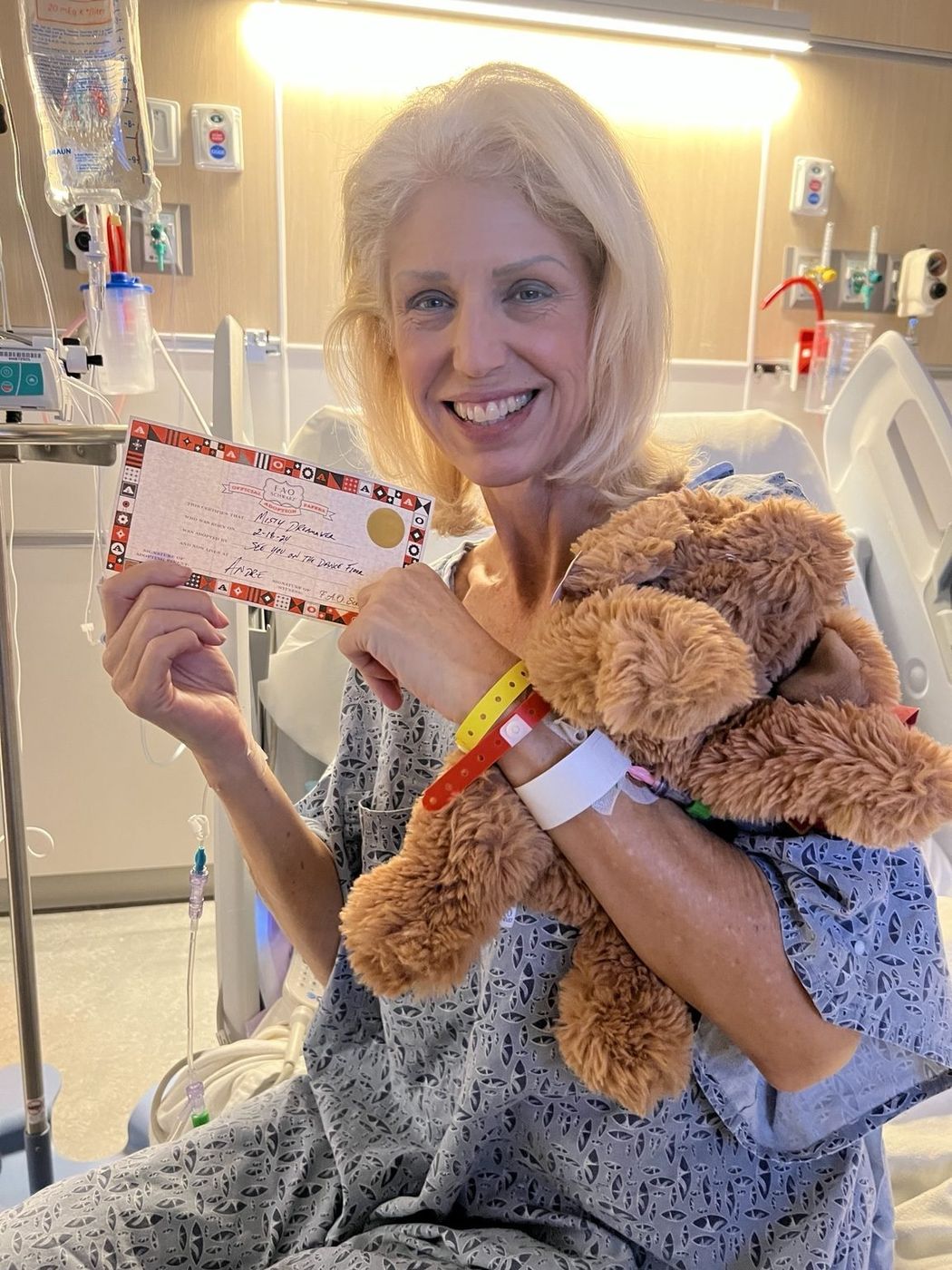
After she was gone I lay in the beeping and did something I had not done in years, which was to stop performing. There was no one left in the room to perform for. And when I stopped, the strangest thing happened. I could feel all of them in there with me.
The four year old crossing an oil field alone with a lunch bag held in both hands. The twelve year old going door to door in Riverside with a stack of flyers her mother helped her letter. The girl in a bowling alley on her honeymoon, holding a pencil over a scoresheet she could not read, feeling her new husband decide something about her. The woman on the phone from Amsterdam, saying she was fine. The one who signed papers in Mexico in a language she did not speak, alone, because she could not think of anyone to bring.
They were all still here. Not one of them had ever been let go of. They had only been walked away from.
The monitor kept counting.
And somewhere down at the bottom of that night I understood, with the awful clarity you only get at four in the morning, that I was not in that bed because of one bad decision made in a Tijuana clinic. I was in that bed because of a habit. A habit so old I could not remember learning it, so useful I had built a whole life on top of it, and so quiet that not one person in sixty years had ever thought to call it what it was.
I did not start dying in that room.
I started a long time before, on a dirt path in Huntington Beach, California, with the sound of iron moving somewhere out ahead of me in the dark.
PART ONE
The Girl Who Learned to Walk Alone
CHAPTER ONE
Iron Horses
The morning it changed, my mother came only as far as the gate.
I was four. We had walked the path together maybe six times by then, her hand around my whole hand, my school bag knocking against my knee, and I had come to think of the walk as something the two of us did. That morning she crouched down and straightened the collar of my dress and looked at me with an expression I would spend the next fifty years trying to read correctly.
"You know the way now," she said.
I did know the way. That was not the difficulty.
"Go on," she said. "You're a big girl."
So I went on.
Between our house and the preschool there was a field, and in that field there were oil pumps. Dozens of them, spread out across the dry grass all the way to where the light went yellow at the far end. They rose and dipped in a slow patient rhythm, dark heads bowing down to the dirt and lifting again, bowing and lifting, and each one made a long iron sound as it went, a creak and then a sigh, and none of them were in time with each other. So the noise came at you from everywhere at once and never repeated.
I did not know the word machinery. I thought they were animals. I thought they were enormous iron horses drinking something out of the ground that I was not able to see, and I understood, in the way a child understands things, that if one of them decided to lift its head all the way up it could follow me.

I got about a third of the way across before I heard the engines.
They came up out of the east side of the field, three of them, boys on motorcycles who were probably thirteen and looked to me like grown men. They saw a small blonde thing alone in the open and they did what boys do, which was to turn wide and come at me.
I have thought about that morning many times since, and the detail that stays is not the fear. It is that I did not run.
I stopped where I was. I put the lunch bag against my chest with both arms. And I made myself as still and as small as a person can make herself, and I waited, and the bikes came in close enough that grit off the track stung my legs, and one of them swung past near enough that I felt the heat off the engine on my knee. They circled twice more. Then they got bored, the way boys do, and peeled away laughing toward the road, and the sound of them faded out and left me with the iron.
I waited until my legs would hold. Then I walked the rest of the way and I went into that classroom and I did not tell anyone.

That night my mother asked how school was, and I said fine, and it was the first lie I ever told that I can still remember telling. I did not lie because I was afraid of her. I lied because some very fast piece of my mind had already run the calculation and worked out that a girl who came home with problems might not be walked to school again, and a girl who came home fine was a girl who was doing it right.
Go still. Wait it out. Start walking again once they are gone. Tell them it was fine.
I was four years old and I had just built the machine I would live inside of until I was sixty.
If the field were the whole story I would be a different woman, and this would be a smaller book.
But there was also the yard.
My dad kept bees in white boxes along the back fence. His name was Joe, and he was a beekeeper the way some men are fishermen, which is to say it was less a job than a reason to be outside and unbothered. On summer evenings the whole yard hummed. He had pigeons that came down out of the sky when he called them, and chickens, and a horse named Sugar who was patient in the way only enormous animals are patient, and a poodle named RC who had gotten it into his head that he was responsible for the chickens. He walked ahead of them. They followed. He looked back to check on them. We laughed so hard at that dog that my mother had to hold the fence.

And there was the bay.
My mother took us down some afternoons and she would find a smooth stretch of wet sand and kneel over it, and she would draw a horse with one finger. Not a child's horse. A real one, with the neck arched and the mane thrown over and the legs caught at full gallop, and she made it look like it took her no effort at all.
I would stand next to her with my toes in the cold edge of the water and watch it appear.
"Can you teach me that?"
"There's nothing to teach," she said. "You just draw what you see."
That was not true, and I think she knew it was not true, and I have forgiven her for it because she was twenty four years old with three children and no earthly idea that the thing she was doing carelessly in the sand was the thing her daughter would be reaching for at sixty. The tide always took it. That never once occurred to me as sad. What I understood was that she could make something beautiful out of nothing and that it did not have to last in order to have been worth making.
Hold both of those pictures at the same time, because I lived in both of them at the same time. A girl who was learning to go still and lie about it. A girl who was learning that beauty could be made out of whatever was lying around.
They were the same girl. She would need both.
CHAPTER TWO
The Shed at the End of the Drive
My great grandmother lived out in Yucaipa, and going there was the best thing that happened to me in the first ten years of my life.
Everybody came. That was the point of it. Cars up the dirt drive all afternoon, my grandmother's sisters, cousins I only ever saw at that house, somebody's new husband standing around not knowing where to put himself. The adults would get loud out on the porch and the children would run the property until we were filthy, and at some hour known only to her, my great grandmother would come down off the steps drying her hands on her apron and say the sentence we had all been waiting for since the car turned in.
"All right. Who's coming with me?"
Every child within earshot stopped.
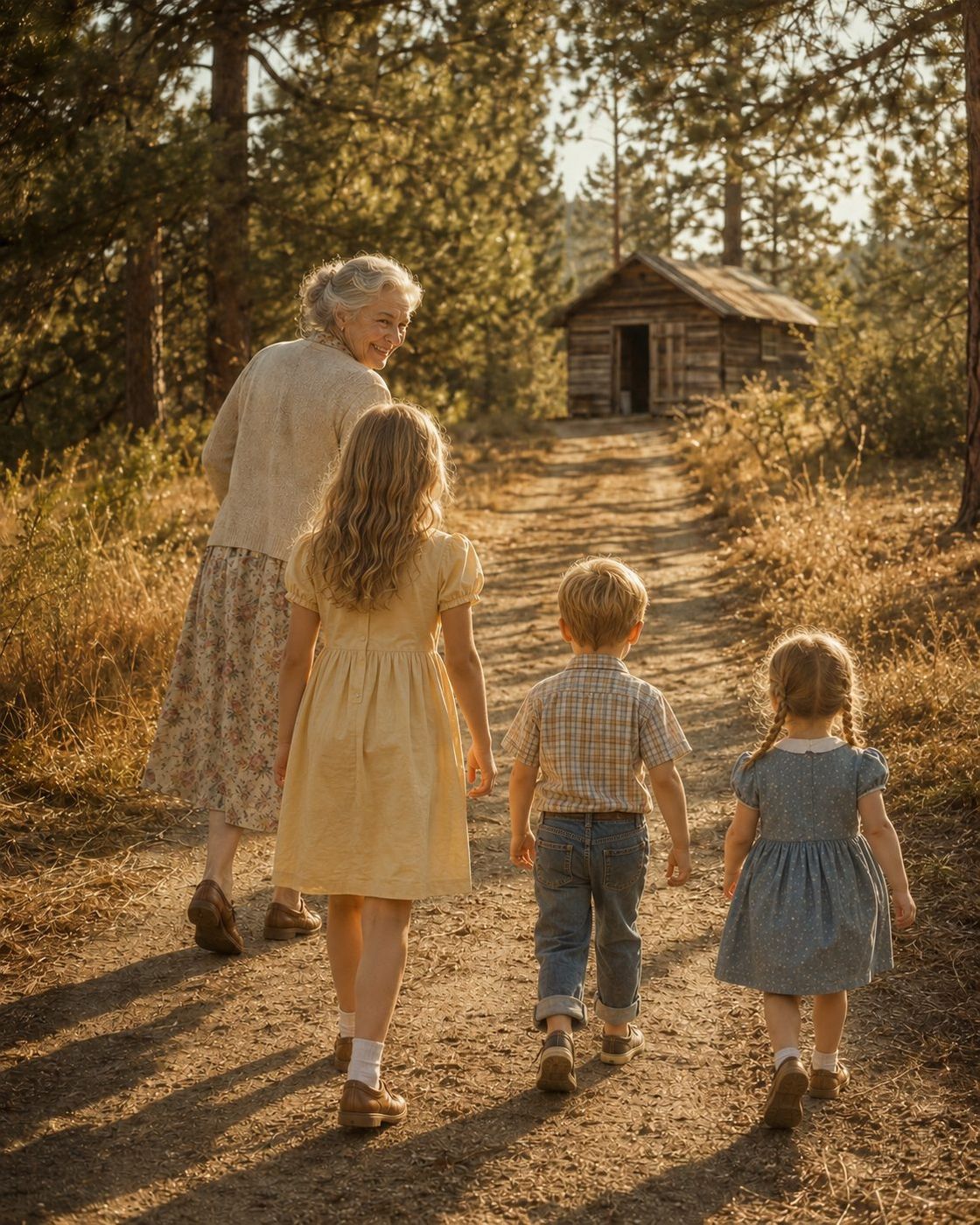
She would lead us down the drive toward a gray board shed that from the outside was the least remarkable building on the property. We called it the magical shed. No adult had ever told us it was magic. We had named it ourselves, on the evidence.
The evidence was this. She would work the latch, and pull the door, and the light would go in ahead of us across a floor of packed dirt, and every wall from the ground to the roofline was shelves, and every shelf was full of glass.
Hundreds of jars. She had put up everything that grew on that land for forty years and never thrown a jar away. Blackberry and plum and apricot and fig, quince jelly the color of a lit lamp, tomatoes, beans, things I could not identify then and cannot now. The afternoon sun came through the one small window and went straight into all of it, and the whole shed turned into a church window made out of fruit.
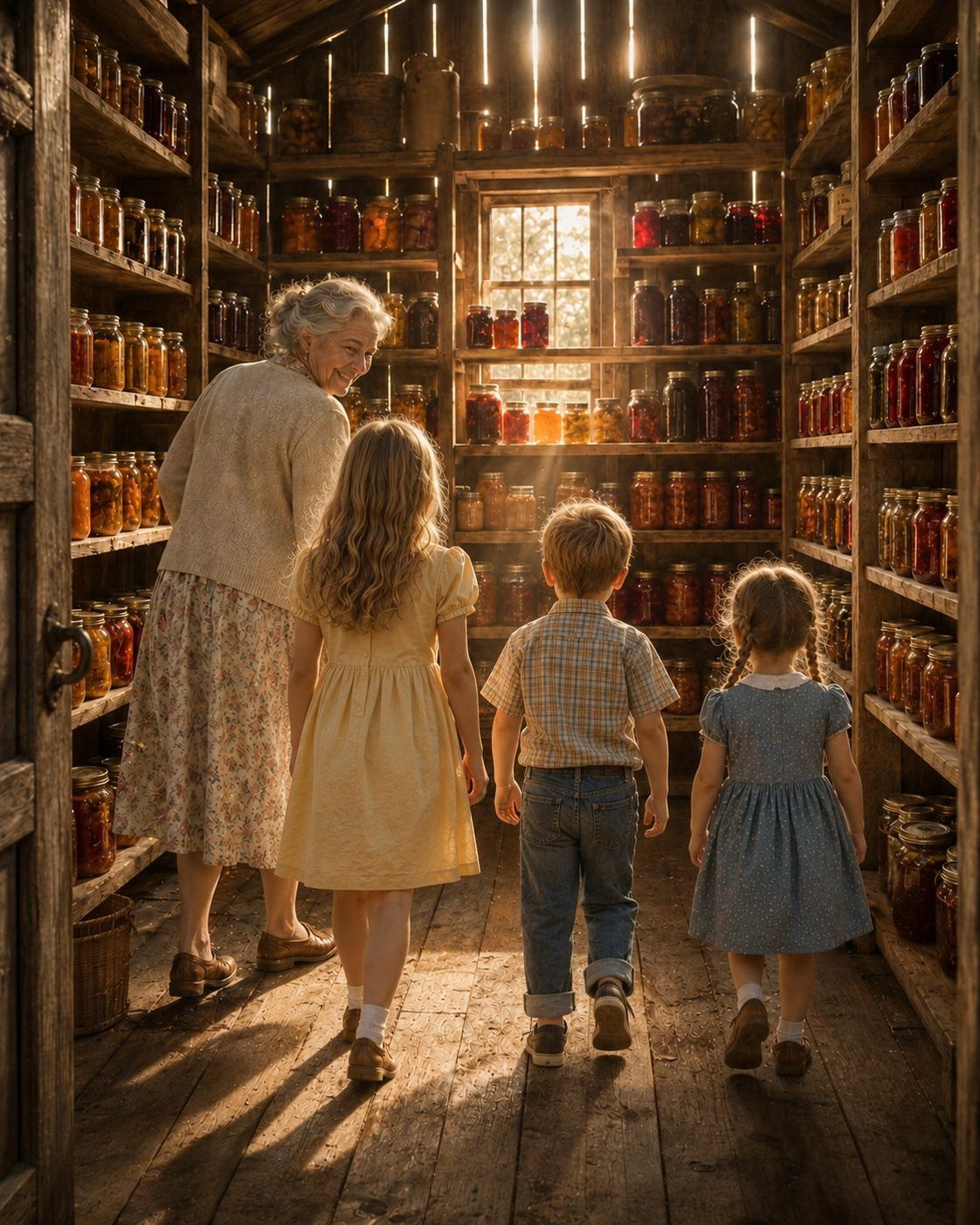
Then she would say the part that mattered most, which I did not understand for another forty five years.
"One each. Go on. Pick your own."
Not one jar passed around to share. Not a jar chosen by a grown up who knew better. Each of us walked those shelves alone, taking as long as we liked, and whatever we came back with was ours and nobody argued.
Do you know what that does to a child who is already learning that her job is to need nothing?
I took a very long time. My brother had his in about nine seconds. I went up and down those shelves like a woman at an auction, and I finally stopped in front of a persimmon marmalade, and I want to be honest with you about why I stopped, because it was not the persimmon.
It was the jar.
She had put that one up in cut crystal. I have no idea why. Some jar left over from a wedding, some piece of a set that had broken. But it was heavy faceted glass with a pattern cut into it, absurdly fine for a shed with a dirt floor, and when I lifted it off the shelf and turned it into the window the sun went into all those cut faces at once and came apart.
The marmalade lit from the inside. Orange going to gold going to a deep burnt amber down at the bottom, and the light moving through it slow like it was thinking.

"That one?" she said behind me.
"This one."
"Hm." She came and looked over my shoulder at it for a second. "That's just persimmon. That's the same as all the rest of them."
"No it isn't."
And my great grandmother, who was not a sentimental woman and who had buried a husband and worked that ground her whole life, laughed once and said, "No. I suppose it isn't. It's what you're holding it up to."
Then she went to help somebody else reach a high shelf, and I stood there in the dirt and the dust with a jar of preserves in both hands, four years old or five, feeling something enormous go through me that I had no word for at all.
I did not eat it for months. My mother finally made me, and it was very good, and it was only persimmon.
There were two pine trees at the top of that drive, fifty feet if they were an inch, and my brother Troy and I climbed them every time we came.
All the way up. Past the point where the branches got thin enough to bend under a foot, up to where you could feel the whole tree take the wind and lean with it and come back. We would sit up there swaying, filthy, absolutely certain we had gotten away with something, listening to the adults' voices going on far below us and not one of them looking up.

How neither of us came out of those trees I will never know.
I have thought about that shed more than almost anything else in my life, and it took me until I was in a hospital bed to work out why. It was not the jars. It was that for one afternoon a year, an old woman in an apron handed a child the right to choose something precious for herself, and then did not supervise the choosing, and then did not take it back.
Nobody would do that for me again for a very long time.
I would have to learn to do it myself, and I would be almost sixty before I managed it.
CHAPTER THREE
Poor, Wild, and Free
When I was ten my father came home and said a man he knew in Oregon had a job for him.
I remember the kitchen. I remember my mother standing at the counter with her back to him, not turning around, and the particular quality of her not turning around.
"He said it's waiting," my dad said. "He said it's mine when I get there."
"Did he put that in writing, Joe."
"It's Bill. You know Bill."
"I know Bill," my mother said.
We sold the house.
I want to say that again, because I was ten and I did not have the vocabulary for what I was watching and I want you to have it. On the word of one friendly man, with nothing on paper, my parents sold the house they owned, loaded three children and a dog into a car, and drove eight hundred miles north into the rain.
There was no job. There had never been a job. Bill was apologetic and vague and then he stopped coming around.
By that winter we were on state assistance and living in a shack in the woods outside Florence.

I am going to tell you the truth about that year and it is going to sound wrong.
It was the best year of my childhood.
The shack leaked. The floor sloped hard enough that a dropped marble went to the east wall every time. There was a lake across the road and another one a half mile back through the trees, and in between there was nothing but Douglas fir and salal and sudden bare sand dunes that had no business being there, and blackberry. Blackberry everywhere, in hedges taller than my father, so heavy in August that the canes bent to the ground.
We picked them every single day of the season. We came home purple to the elbow. We ate so many we made ourselves sick and then went back out the next morning and did it again.
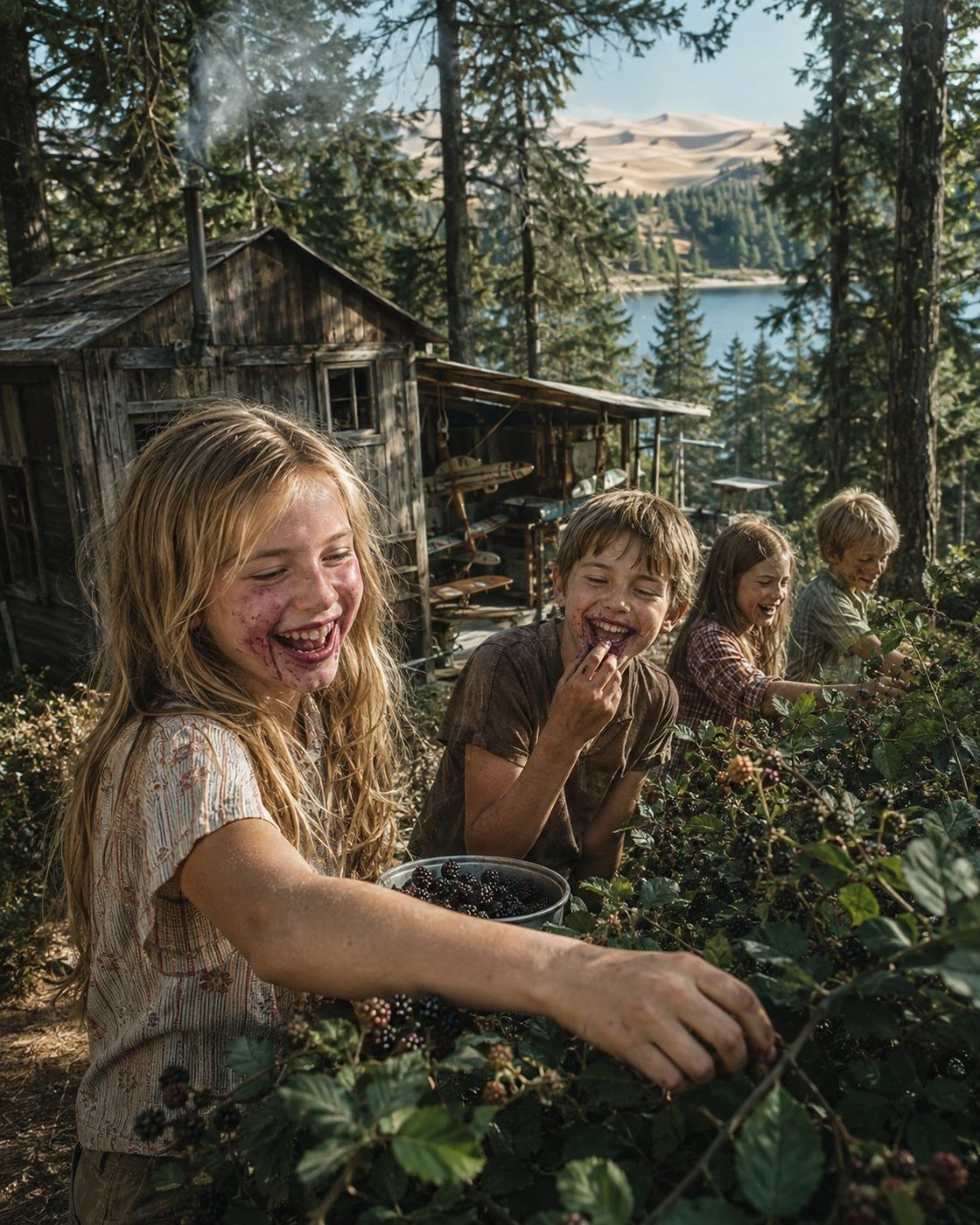
My father built himself a workbench in the lean to off the side of the house, and that shed is where he lived that year. Wires and tubes and balsa and half a radio, and model airplane parts laid out in rows on a board. He was always six weeks away from inventing the thing that would fix everything.
I sat out there with him some nights while it rained on the tin. He would hand me a piece and say hold this, and I would hold it, and he would work and not talk, and it was the most peaceful I ever was around my father in my entire life.
He never invented the thing. I want to be fair to him here, because I am going to have to be unfair to him later. Joe was a man with a good mind and no map for it. He had ideas the way other men have opinions and he had absolutely no idea how to turn one into money, and I think some part of him knew that, and I think that is where a good deal of the cruelty came from later.
My mother made the assistance stretch. That is its own kind of engineering and nobody gives you a medal for it.
And the three of us ran wild in some of the most beautiful country in America and did not know for one minute that we were poor.
Here is the thing I took out of that year and carried for fifty years without examining it.
My father made a catastrophic decision on nothing but somebody's word. It cost us the house and a year of my mother's life. And it produced the happiest twelve months any of us ever had together.
So what was I supposed to learn from that?
I learned that you cannot tell from the outside of a year what is living inside it. That is true and it is beautiful and I still believe it.
I also learned, underneath it and without ever saying so, that a person can gamble the roof over her children's heads and be forgiven, because look how happy everyone was. That one was not true. That one I would carry into three marriages and a dozen businesses and one clinic in Mexico, and it would take almost everything from me before I set it down.
CHAPTER FOUR
Words That Would Not Stay Still
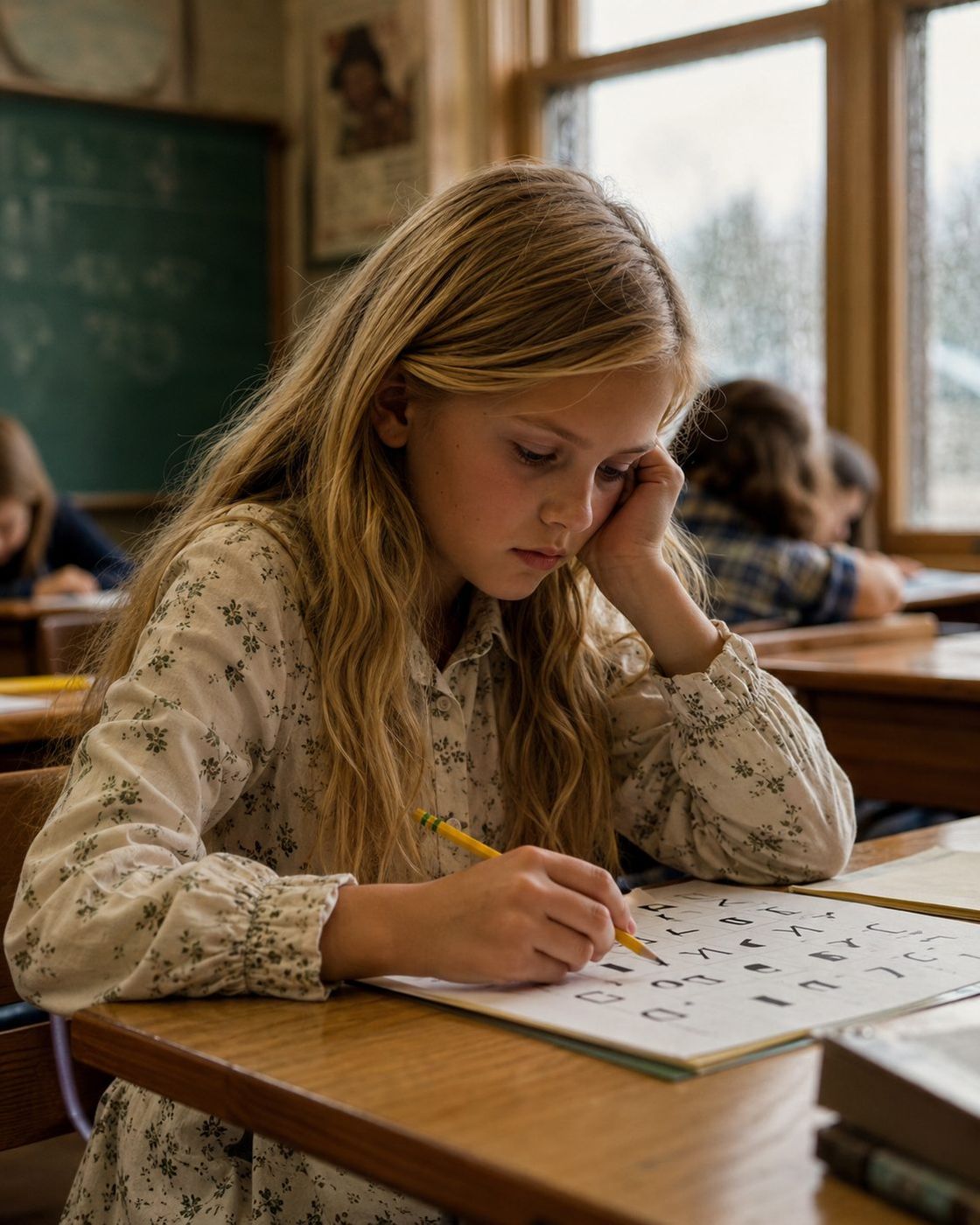
In Oregon they put me in the slow class, and it was the happiest I had ever been at school.
That is not a joke and it is not brave irony. There were nine of us in that room. The teacher was a heavy calm woman who let you take as long as you needed and did not sigh while you took it. Nobody laughed when I read out loud. For one year I was not behind, because in that room there was no in front.
What I did not know was that the principal had already been to see my parents about holding me back.
I found that out the way children find things out, which is by standing in a hallway at the wrong moment.
"She's a sweet girl," he was saying. "But she's not going to keep up. It's kinder to give her the year."
And my father said, "She's not slow."
"Nobody said slow."
"You said it," my father said.
I stood in that hallway with my coat over my arm and something happened in my chest that I have spent my whole life trying to describe. Gratitude and shame arriving at exactly the same time, and neither one of them cancelling the other, so that I never afterward learned how to be defended without also feeling accused.
Nobody said the word dyslexia to me until I was well into my thirties.
Before that there was only the daily evidence. Letters that swapped themselves while I was looking straight at them. A column of numbers that would not hold still long enough to be added. The particular exhaustion of reading a paragraph three times to get what everyone else got in one pass, and then having to act as though you had gotten it in one pass.
What that produces in a child is not stupidity. It produces a magnificent, exhausting, second by second performance of ordinariness. And I got very good at it. I learned to read a room instead of a page. I learned to watch which way people's eyes went and get there first. I learned to be funny at exactly the moment somebody was about to ask me to read out loud.
Every survival skill I would later sell as a business talent, I built in a classroom, out of fear.
In second grade, back in California, I fell in love with sign language.
I do not entirely know why. There was a girl at church whose brother was deaf, and I watched them one Sunday having a whole conversation across a room with nobody able to overhear it, and something in me stood straight up. A language you could hold in your hands. A language where the letters could not run.
I went to my teacher about it. I can see her desk. I can see the coffee cup and the wooden apple somebody had given her.
"I want to learn sign language," I said. "I want to teach it."
She looked at me for a moment. And then she said, not cruelly, which is somehow the worst part, in the ordinary voice of a woman correcting a small factual error:
"Honey, you can't even spell. You have to be able to spell to sign."
That is all. That is the whole event. It took eleven seconds and she had forgotten it by lunch.
I quit. I never took it up again. I am sixty years old and I cannot sign, and every few years I meet someone who does and I feel the loss come up out of the floor at me like a draft.
There is a particular kind of theft that happens to children, and it is almost never violent. An adult offers an opinion in the middle of an ordinary Tuesday, and a child, who has no way to weigh an opinion against a fact, files it as a fact. And it stays filed. And she will build around it for forty years.
I have to tell you about the brothers, and then I am going to move on, because I have decided not to give them more room in this book than they had in my life.
I was nine or ten. There was a boy I liked in the fourth grade. He had two older brothers, and the three of them would get me into the back room of that house, and the older ones would tell the younger one what to do to me, and stand there.
I did not fight. I have had to sit with that sentence for most of my life.
I did not fight because I could not work out what was happening, and because the only friend I had in that town was the boy in the fourth grade, and some fast small piece of my mind had already run the numbers and decided that whatever this was, it was the price of not being alone.
Afterward I would walk home. I would come in the back door and my mother would ask how it was and I would say fine.
Go still. Wait it out. Start walking again once they are gone. Tell them it was fine.
Six years old in a field, and ten years old in a back bedroom, and the machine ran the exact same way.
I never told my family. Not that year and not for decades. And if you are carrying something similar, I am not going to hand you a lesson about it, because there is no lesson in it. There is only this, which I wish somebody had said to me at ten and which nobody did: what was done to you is not a thing you agreed to just because you did not know how to stop it.
Not long after, we left Oregon and came back down to Riverside, and I started over as the new girl again, and I was very good at that by then.
CHAPTER FIVE
Becoming Visible
The first business I ever built, I built at my mother's kitchen table with a ruler and a black felt pen.
I was twelve. I wanted a moped, which cost more money than existed in our house, and I had worked out that the neighborhood was full of women with small children and no evening.
"You'll need a flyer," my mother said.
She showed me how to rule the lines in pencil first so the letters would sit straight, and then how to draw the letters heavy and open so they read from a distance, and then how to erase the pencil after the ink was dry. She was good at it. She had that same hand she used on the sand.
"Put your phone number at the bottom four times," she said, "so they can tear one off."
Then I went out and knocked on forty doors.
That is the part people always want the trick for, and there is no trick. You walk up the path, and your heart is going, and you knock, and a woman opens the door with a dish towel in her hand and a toddler on her hip and a look that says whatever you are selling, no. And you say, "Hi. My name is Misty and I live on the next street and I babysit."
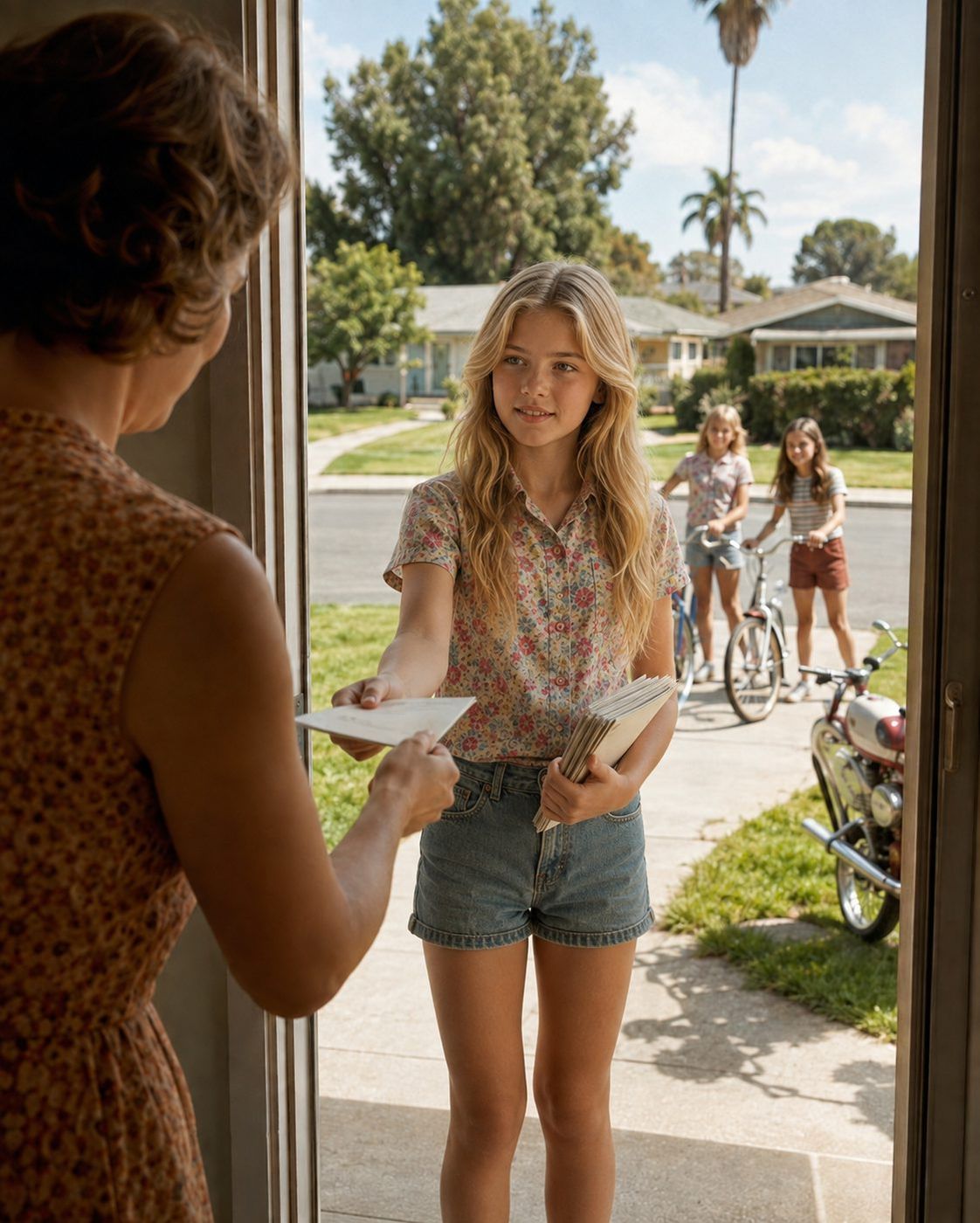
Four of them said yes that first week.
Inside of three months I had more Friday nights than one twelve year old could cover, and I did the only thing that made sense, which was to go find four girls from school and give them the overflow and take a cut. I did not know that had a name. I thought I was solving a scheduling problem.
I bought the moped in the spring.
I cannot explain to you what that machine was. It was not transportation. It was the first object in my life that answered to me. I could decide, at two in the afternoon, that I wanted to be somewhere else, and then be somewhere else, without asking one single person. For a girl who had spent her whole childhood being driven places and left places and moved states on the word of a man named Bill, that little engine between my knees was the closest thing to sovereignty I had ever held.
My grandparents decided around then that I needed polish.
The word they actually used, and I heard them use it through a door, was that I was a slob. Which was not wholly unfair. I had spent a year in the Oregon woods and I still ate like somebody was going to take the plate.
So they paid for charm school, and I want to record for history that it was the single best thing anyone in my family ever did for me, and that they did it as a criticism.
Six weeks in a rented room above a shop, learning how to walk into a space. How to stand so that your weight is under you. Where to put your hands when you have no idea what to do with your hands. How to enter a conversation and how to leave one. A woman named Dolores with a cigarette voice who told me my chin was down.
"Up," she said, tapping under it with two fingers. "You are not apologizing. You are arriving."
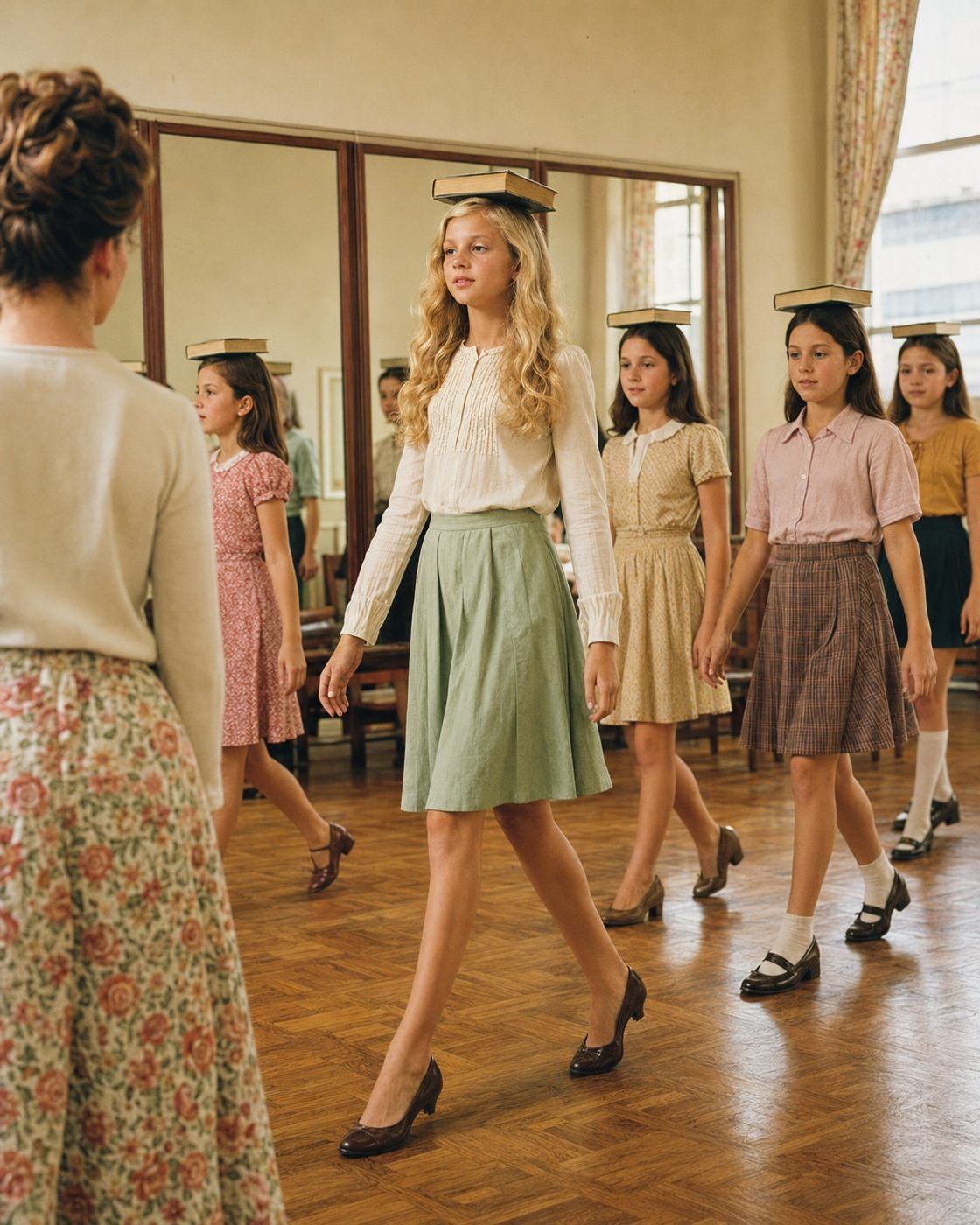
I walked out of that room a different animal.
It led to an agency, and the agency led to jobs, and here is where I have to tell you the other half.
Not everyone with a camera is a photographer. I learned that at fourteen in a converted garage in Anaheim with a man who kept saying the light was better in the back. I got out of that one. I did not get out of another one quite as clean. And I told nobody, again, because I had a system for this by now and the system was working, or at least the system was quiet.
My parents were not much help. Jobs got cancelled, permissions did not get signed, and I got very used to putting a garment bag over my shoulder and getting myself to a call on a moped in the rain.
However I could manage it, I made it happen. If you wanted one sentence for the first half of my life, that would do.
The other thing I did at that age was read.
There were no mentors in my house. Nobody had run a business, nobody talked about money except as a thing there was not enough of, and nobody was going to sit me down and explain how any of it worked. So I went to the library and I found men who would.
Napoleon Hill told me that wanting was not the same as deciding, and that a thing you have not written down is not a goal but a mood. Dale Carnegie told me to stop trying to be interesting and start being interested, which changed every room I walked into from that day forward. Zig Ziglar tied getting to giving. Og Mandino gave me the habit of repetition. Later, Covey gave me a language for values I had been operating on without being able to name.

Understand what those books actually did for a girl who had been told she could not spell.
They were the first adults who spoke to me as though I were capable. They had no way of knowing about the slow class, or the sign language, or the letters that would not hold still. They simply assumed, on every page, that their reader was a person who could learn a thing and then go do it.
Nobody had assumed that about me before. I sat on my bed with those books open on my knees and understood, for the first time, that ability might be something you build rather than something you are issued.
And then, in tenth grade, I got on a stage.
Chamber Singers was the good choir, the one that danced, the one you had to audition for. My friend Paula and I went in together. She was popular and would drop me the instant one of her real friends said anything about me, and she was also, when it was just the two of us, the best company I had. People are allowed to be both. I have needed that fact for most of my life.
We both made it.
Here is what happened to me in that room. On a page I was slow. In a hallway I was strange. But in a group of thirty people learning a piece of choreography, I was fast. My body understood the shape of a thing about four counts before my mind did. Nobody in that room knew I read like a struggler, because reading was not the currency.
At the end of the year they gave out awards, and the class voted, and they gave Most Improved to me.
I have won things since that were worth more money. I have never once felt anything like it. I stood up in front of people who had known me two semesters as the odd new girl, and they were applauding, and I could not make my face work correctly, and I sat back down holding a small cheap trophy and thinking, over and over, they had to vote for that. Somebody had to write my name down.
It came with free voice lessons. I took every one.
CHAPTER SIX
The Certificate
My father and I had a fight in the kitchen when I was fifteen and I do not remember what it was about.
That is not evasion. I have tried. It was a Tuesday kind of fight, the kind we had constantly by then, and it escalated the way they always did, and at some point I said something clever, because I had learned that I was quicker than he was and I was not above using it.
He stood there breathing. And then he said it.
"You know I'm not even your father."
I laughed at him. I want you to understand that. I laughed, because it was such an obvious, cheap, losing thing to say, and I told him he was pathetic, and I went to my room.
My mother came in about twenty minutes later with a piece of paper.
She did not say anything. She just sat down on the edge of the bed and held it out, and I took it, and it was my birth certificate, and there was a man's name on it that I had never seen before in my life.
"Gary," she said. "He's in Arizona."
I looked at that piece of paper for a long time. Then I handed it back to her and said, "Okay."
"Misty."
"I said okay."
What I did with it was what I did with everything by then. I set it on a shelf in the back of my head and closed the door and went to school the next morning. My dad was my dad. A name on a form did not change who had taught me to hold a piece of balsa steady while he glued it.
I did not cry about it for eleven years. I cried about it eventually in a kitchen in the Netherlands with a woman from church I barely knew, over nothing, over a dropped cup.
Four months later I stayed over at a girlfriend's house on a school night, and at seven in the morning my parents were at her door.
The car was already packed. That is the detail. Everything I owned was in that car before anyone woke me up.
"You're going to a foster home," my mother said.
I got in. I did not scream. I want to be able to tell you I fought and I did not, I got in the car, because a version of me that was already ten years old by then had decided that the fastest way through anything is to go still and let it happen.
We drove east. I watched the exits for about two hours before the arithmetic caught up with me, and then I said, to the back of my father's head, "There's no foster home."
Nobody answered.
"We're going to Arizona."
Nobody answered.
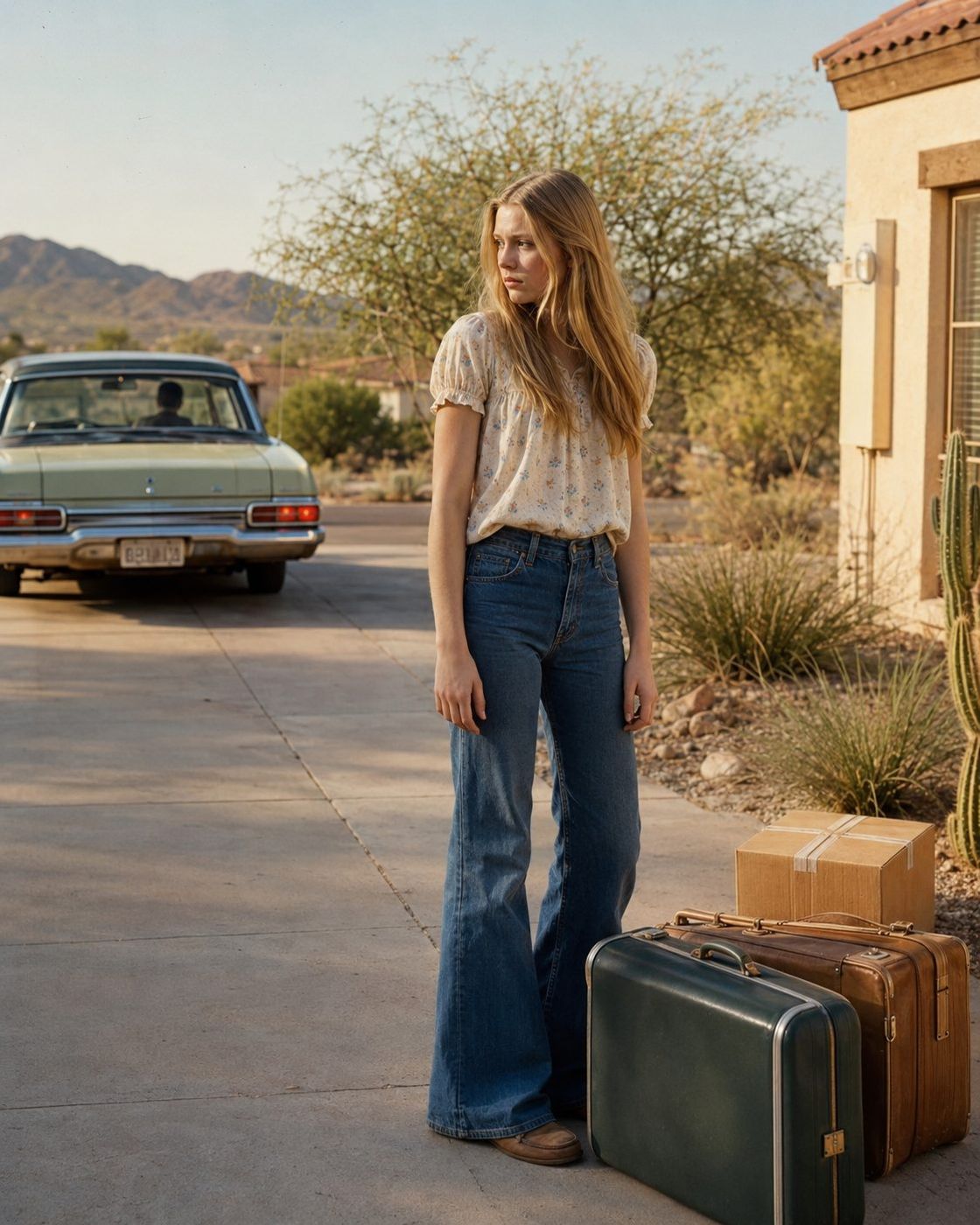
Somewhere past Blythe I went into my bag and took out a bottle of pills and swallowed what was in it.
They must have been close to nothing. Vitamins, or aspirin, or something my mother kept for headaches. I was sick for an hour and nobody stopped the car and nothing else happened. I have never told that story at a podium because it does not have a useful ending. There was no rescue and no revelation. A fifteen year old girl reached for the only exit she could find in the back seat of a moving car, and the exit did not work, and the car kept going.
What I want you to sit with is not the pills. It is the eight hours afterward. Because after that, we still had four hours to drive, and I was still in the car, and at some point somebody put the radio on.
Gary was standing in the driveway when we pulled in. He had been watching for the car.
He was a good looking man in his late thirties with a pilot's forearms and an enormous grin, and he came off that step like the whole thing was a party, and my parents got out and unloaded my life onto the concrete in about six minutes and left.
They did not come inside. They did not stay for coffee. My mother hugged me at the car and my father did not, and then there was a Buick going back down the street and I was standing next to a stranger with my suitcase.
"Well," Gary said. "You hungry? Because I'm taking you out."
Here is what my father, my real one, my biological one, did on our first evening together.
He drove me across town to a small stucco house and introduced me to a beautiful woman in her twenties who was not his wife, and the three of us sat on her floor and drank sake, and he let me drink it, and he watched me with enormous pride the entire time. Then he took me to a bar where he knew everyone and walked me around it like a trophy. This is my daughter. Look at her. Then Mexican food at eleven at night.
He was married. Her name was Loretta and she was at home. He had a little boy, my half brother, asleep in a room in that house.
And I, at fifteen, sitting in that bar with a drink in front of me and a man's hand on my shoulder saying look at her, felt something I had not felt in a very long time, which was chosen.
That is what I need you to understand about my life, and it starts right here, in a bar in Prescott, Arizona, in 1981.
I could not tell the difference between being loved and being displayed. Nobody had ever shown me the difference. And a man who displays you is so much easier to find than a man who loves you.
The other thing Gary did was put me in an airplane.
He flew crop dusters and light commercial, and about three weeks in he took me out to the field at six in the morning and put me in the left seat of a Cessna 172 and said, "Feet on the pedals. Hands here. Don't strangle it."
We flew Prescott to Phoenix and back. He talked the whole way and let me hold it straight and level over the high desert with the sun coming up on my side of the glass, and at some point he took his hands off entirely and folded them in his lap and said, "You've got it."
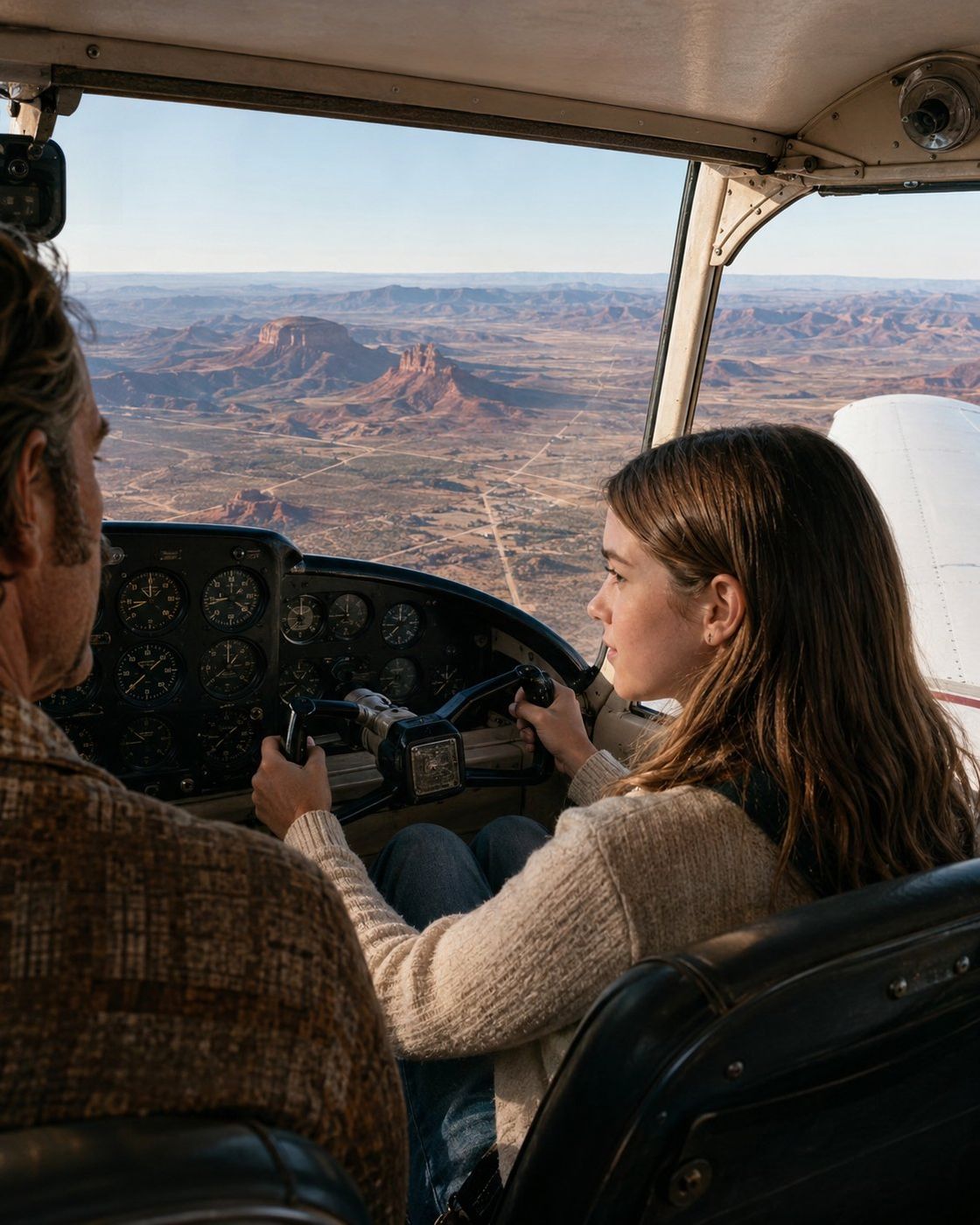
I want to be exact about what happened to me up there, because it was not joy. It was recognition.
He told me his grandfather had been a test pilot for the government. He told me about the businesses he had started, the health food store he was running, the three before that. He was restless and inventive and completely unable to stay inside any structure for longer than eighteen months, and he was the first person I had ever met whose mind ran the way mine ran.
I had spent fifteen years being the strange one in a family of people who were not strange in that particular direction. And it turned out I was not strange. I had simply been raised in the wrong tree.
He was also a con artist. I need to put that down in the same paragraph, because both of those things were true of him at once and I have spent my life around men of whom both things were true at once. He was working an angle on somebody every single week I lived there. Two more daughters showed up out of his affairs over the years, half sisters I barely got to know.
I lasted less than a year in Arizona. What ended it is a story I am not going to tell here.
I went back to California, and my parents' marriage came apart within months of my return, and when it did the family divided like an estate. My mother took my sisters. My father took my brother.
And I, at sixteen, was left in a house that had already been sold.
I remember the last week in it. Boxes. My footsteps sounding different in the emptying rooms. I had a job at a children's shoe store that I loved and that paid part time wages, and I stood in that kitchen doing the math on a legal pad and understood that I would have to give up the only work I had ever enjoyed in order to eat.
Nobody sat me down and taught me how to be an adult. I simply became one on a Thursday, because the alternative was the street.
I found two roommates and an apartment. I took a full time job I did not like. I made a little over four hundred dollars a month and there was not enough of it for food, and I am going to be honest with you about how a sixteen year old girl in 1982 solved that problem, because it is in every one of the chapters that follows.
I went on dates with men who would feed me.
PART TWO
The Woman Who Built Instead of Leaving
CHAPTER SEVEN
The Score
He crossed the whole showroom floor to get to me, and I have to admit that I liked it.
I was seventeen, working retail, and he came in the front and did not look at anything for sale. He came straight across the tile in a way that made two other customers move out of his path, and he put out his hand and said his name like it was a fact I was going to need.
He was thirty one. He was an officer. He had been to places I had only ever seen the names of.
We went out that Friday. He ordered for both of us and I let him, because I did not know how to read half the menu and he had just solved that for me without ever knowing there was a problem.
Two weeks later he shipped out to Germany for a month, and we wrote, and somewhere in those letters we decided we would get married. I want to be truthful about the arithmetic in that decision. He was being reassigned to Georgia. I was seventeen in an apartment I could barely hold, eating on other people's money. Marriage solved a logistics problem for him and a survival problem for me, and we both dressed it up as romance because that is what people do.
Two weeks after he came home, we did it.
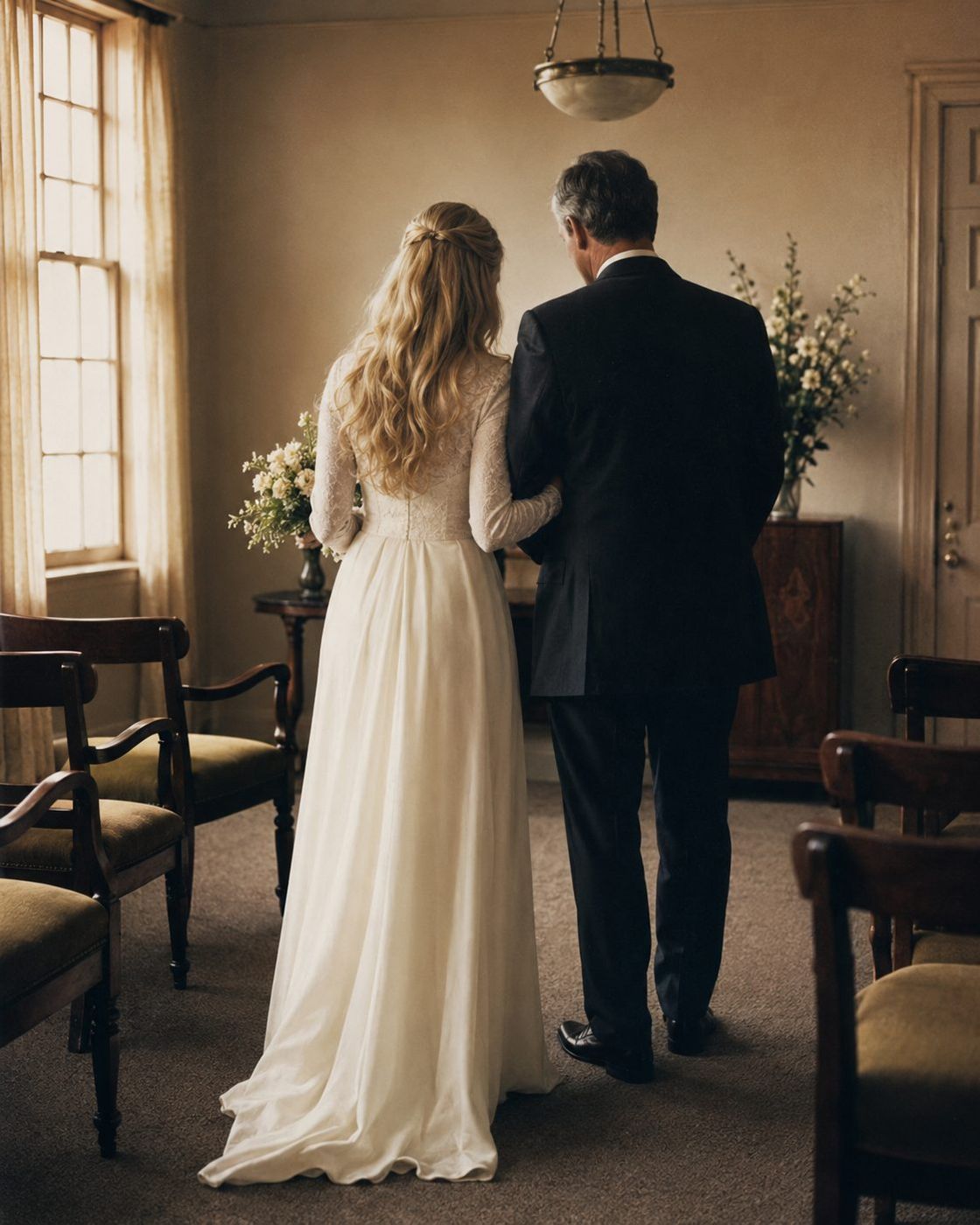
On our honeymoon he took me bowling.
It was a Tuesday afternoon and the place was almost empty, and I can still bring back the sound of it, the crash from two lanes over, the rumble of the ball return, the smell of the rented shoes. He was in a wonderful mood. He got the lane and paid for the shoes and did the thing he liked doing, which was to be a man handling arrangements.
I had never bowled. Not once. He found that charming and I let him.
Then he slid the scoresheet across the little table and put the pencil on top of it and said, "You keep score."
The grid was a page of small squares with smaller squares inside them.
I said, "You do it. You know the rules."
"It's not hard. Ten frames. Strike is an X."
"I'd rather watch you."
"Misty." He was still smiling. "Just keep the score."
So I took the pencil. And I sat down in that orange plastic chair and looked at the sheet, and the boxes did what boxes had always done, which was to slide very slightly and refuse to stay in their rows. I got the first frame down. Then he threw a strike and I put a number where the X went and he leaned over and said, "No. No, that's not it."
He took the pencil out of my hand.
He did not shout. He did not say anything unkind. He erased what I had written, and he redid it, and then he looked at me for a second and a half with an expression I had never seen on his face before and would see for the next eleven years.
Then he said, "Huh," and went to bowl.
That is it. That is the entire event. Nobody raised a voice. If you had been sitting in the next lane you would not have looked up.
But something got decided about me in that half second, and it was never undecided.
I did not have the word dyslexia until I was thirty six years old.
If I had had it at eighteen I could have said, in that bowling alley, the letters and numbers move on me, it has nothing to do with what I understand. And he might have been decent about it. I genuinely do not know. He never got the chance to be, because I did not have the word, and so what I said instead was nothing, and what he concluded was the only thing available to conclude.
He had married a beautiful girl who could not keep score.
From that afternoon on, there was a tone. It came out at dinner parties, always as a joke, always with a hand on my shoulder. Don't ask her to figure the tip. She's decorative. And people would laugh, and I would laugh, and I got so accomplished at laughing that I could do it while something in my chest was going down like a slow elevator.
It was not violence. I want to be careful and truthful. There were good years in there, and there was a man who could be very funny and who was proud of me in front of his friends. It was simply that a verdict had been entered early, and everything after it was evidence.
So I did what I have always done when a room decides something about me.
I went and built something in another room.
At eighteen, in Warner Robins, Georgia, I opened a modeling school. I rented a hall on Thursday evenings. I put an ad in the paper and taught teenage girls the exact thing Dolores had taught me, which was how to walk into a space without apologizing for arriving in it.
I took a job at the front desk of the Holiday Inn, and within four months I was running their entertainment, booking acts into the lounge and filling a room on a Saturday night. My husband thought it was a hobby. I let him think that. The books I had been reading since I was twelve were sitting in my head the whole time, and I was running experiments out of them every single week on real people with real money.
I was nineteen years old, and by then I had already worked out the shape of the next forty years, though I could not have said it out loud.
If I could not be respected at my own table, I would go be excellent somewhere else, and bring the excellence home, and set it down in front of him like a cat brings a bird.
He never once picked it up.
CHAPTER EIGHT
The Voice in the Drive-Through
It took a year to get pregnant and I took every month of it personally.
I was in cosmetology school full time by then and still running the modeling school on Thursdays, and every twenty eight days my body handed down the same verdict, and I filed it with all the others. Slow. Decorative. And now this.
I told exactly one person how much it was hurting me, and I told her in a laundromat.
Her name was Linda. We had met over a broken dryer and we were both married to military men and we were both, it turned out, counting days. She said it first. She said, "This is my ninth month of trying and I hate everybody," and I started to laugh and then I started to cry, and she moved her basket over and sat down next to me on the plastic bench.
She became the best friend I have ever had.
When it finally happened for both of us, we came in ten days apart.
My pregnancy was easy right up until the last month, when I discovered that a hot fudge sundae is a complete food group and had one every single day. I got enormous. I have no regrets and I would do it again.
On my due date my blood pressure came back high enough that they induced me that afternoon. It was a military hospital and the labor took two days, and the epidural kept being allowed to wear off, and by the end of it I was somewhere outside my own body watching a woman work.
Then they put her on my chest and the entire world went quiet.
Shay LaVee. Seven pounds and furious about it.
I lay there with her and I understood something I had not understood in eighteen years of trying to be good enough for people. This person had not heard any of it. Not the second grade teacher, not the bowling alley, not one word. To her I was simply the warm place and the sound she turned toward. I had not earned her and I could not lose her by getting a number wrong.
She grew into a performer before she could talk. She would stand in the middle of a room and tell a long involved story with her whole face and both hands and not one recognizable word in it, then wait for the laugh. She still does this. She is in her forties. She was about three months old on the morning Linda and I decided to drive out to the flea market.
It was cold and gray. We had the two babies and two car seats, and those seats in that era were miserable rigid things, and getting Shay into hers was a two person wrestling match every single time. I had her bundled in a snowsuit which made it worse.
I stood in the driveway with my daughter in my arms and thought, entirely reasonably, that I would just hold her. It was fifteen minutes. People did it constantly. My own mother had driven me around California on her lap.
And a voice went off inside my head.
I have never known how to describe this so that it does not sound like something I am adding for effect, so I will simply tell you what it was like. It was not a feeling. It was not a hunch. It had volume. It was the four words put her in her seat, and it came again immediately, and again, and it did not stop, and it was loud enough that I actually turned my head.
Linda said, "What?"
"Nothing," I said. And I put my daughter in her seat and fought the straps closed.
We stopped for coffee on the way. I remember the girl at the window had a cold. I remember I had not put my own seat belt on because I never did, nobody did, the belt lived buried in the crack of the seat under everybody's coats.
And sitting in that drive-through lane with a paper cup in my hand, it came back.
Put your seat belt on.
Same volume. Same insistence. Over and over while Linda counted out change.
I dug the belt out from under the coat and buckled it, and Linda looked at me sideways and said, "Well aren't you fancy."
We pulled out onto a four lane road with a median down the middle of it.
I saw the car maybe two seconds before it reached us. It came out of a side street on our left, going far too fast, and it crossed one lane and then the second lane and then it came over the median, and it was pointed directly at us and it was on the wrong side of the road and it was not slowing down.
I do not remember the noise.
What I remember is afterward. I remember coming back into myself with my knees somewhere they should not have been, in the dashboard, and my mouth full of grit that turned out to be pieces of my own teeth. I remember that the man in the other car had gone through his windshield. I remember that I could not get out and that somebody was working on the door.
And I remember screaming for my daughter, over and over, until a woman I never saw again put her face in the window and said, "She's out. Somebody's got her. She's fine."
Shay was fine. Not a mark on her.
Linda had a sprained wrist and a bad ankle.
And Linda's son, the baby she had spent ten years praying for, took a head injury in that car that he did not recover from. It changed how he walked. It changed how he moved his hands. It changed his whole life, and it changed hers, and it is not mine to describe further than that.
I have carried that for forty years and I have never once been able to make it come out even. My daughter was in her seat because a voice told me twice. Her son was in his seat too.
So I do not get to stand up and tell you that listening saved us. I only get to tell you that I listened, and that I am here, and that Linda's boy is who he is, and that both of those facts have to live in the same sentence forever.
What I did take from that intersection is smaller and harder and it took me thirty more years to apply it. There is information inside a person that arrives before the reasoning does, and I had just been given absolute proof that mine was worth obeying.
I obeyed it for my child that morning without a second's argument.
It would be a very long time before I obeyed it for myself.
CHAPTER NINE
Seven Floors
Two months after the accident we moved to the Netherlands, and I can tell you the entire story of those years in staircases.
The first house had seven floors. Seven. A tall narrow canal house with a staircase like a ladder built by someone who hated women, and I climbed it forty times a day with a baby on my hip and a laundry basket on the other arm. The second house had three. By the time we got to the third house, which had two, I stood in the front hall and nearly wept with gratitude.
The country itself was beautiful in a way that kept catching me off guard. Light coming off the water and up onto the ceilings. Bicycles everywhere. Bread that ruined me for American bread permanently.
And the marriage came with us, exactly as it had been in Georgia, because a marriage is not a place. I found the church about four months in, and I found it because I was lonely enough to walk into a building.
It was small. Maybe sixty people. The pastor's wife was named Anneke and she came at me across the coffee afterward with the unembarrassed directness of a Dutchwoman and said, "You are new. You will come to us Sunday. We eat at one."
Not would you like to. You will come to us. I went.
Those people became my family in a way I did not have words for at the time. Anneke taught me to make her mother's soup. Her husband fixed my bicycle twice and refused money both times. When Shay had a fever at two in the morning they were the ones I called, and they came, and it never once occurred to them to mention it afterward.
I had spent my whole life being useful in order to be kept. These people had no use for me at all and kept me anyway.
Through the church I found Aglow, which was a women's organization with chapters all over Europe, and inside of two years I was a vice president of ours and standing on stages.
I was twenty three years old.
The first big conference, I was so frightened in the wings that a woman had to take the paper out of my hands because it was shaking too hard to read from. She said, "Then don't read it. Just tell them something true."
So I walked out and I told nine hundred women about the field with the oil pumps.
I had never said it out loud. Not to my husband, not to Linda. I told them about a four year old going still while the bikes came around, and about telling her mother it was fine, and I looked up somewhere in the middle of it and the room had gone completely silent, and there were women in the third row crying.

Afterward they lined up. That is the part I did not expect. They lined up to tell me theirs, and every single one of those stories was a version of the same story, which is that somewhere a long time ago she had learned that the price of being kept was going quiet.
The girl the second grade teacher told could not spell was standing in front of nine hundred people and they were leaning in.
I want to record what I learned in those rooms, because it became the spine of everything I have done since. It was not about religion. Half those women had a faith and half of them were there because their sister dragged them. What it was about was that a person in pain does not need your verdict on her situation. She needs somebody to sit in it with her and not flinch and not fix it and not leave.
I could do that. I had been in training for it since I was four.
By the third year I was running a salon on the base, keeping a house, raising a child, serving that church, leading a chapter, and holding a marriage together single handed.
And I began to get sick.
Not dramatically. That is the thing about it. Low fevers. My stomach. Headaches that took the afternoon. I went to our doctor, who was a family friend and knew us both, and he ran the tests twice and found nothing, and on the third visit he did something I have never forgotten.
He closed the folder. He did not open the prescription pad.
"Misty," he said. "How much of this are you carrying by yourself?"
"I'm fine."
"That is not what I asked you."
I sat in that chair with my hands in my lap and could not answer him.
He said, "There is nothing wrong with your body. Your body is doing exactly what it is supposed to do, which is to make a noise loud enough that you have to stop. Go home to California for a month. Not with him. Go."
I went. Linda took Shay for me.
And somewhere in the second week, sitting on my mother's back step in the ordinary California sun, I said out loud to nobody at all, "I am not going back to that."
It is the first decision in this entire book that I made for myself.
I want to be honest with you about what happened to it.
I filed for divorce. And within a year we had reconciled and remarried, and I was pregnant with my son, and we moved back to the States so I could have Clay in Alabama, and I told everyone including myself that people can change.
He had not changed. I had simply run out of the strength it takes to be alone, which is a different thing entirely and I could not tell the difference yet.
Clay was born in the spring. He was a beautiful, brilliant, sideways little boy who could take a lamp apart at four and get most of it back together, and he and his sister were the two best things either of us ever did.
We lasted several more years. The tone came back inside of six months.
CHAPTER TEN
The Business of Beauty
I signed the lease on the Amsterdam shop on a Tuesday morning with a set of keys in one hand and a roll of drawings in the other, and the man from the letting agency asked me whether my husband would be coming to look at it.
"No," I said.
He waited, in case there was more.
There was not.
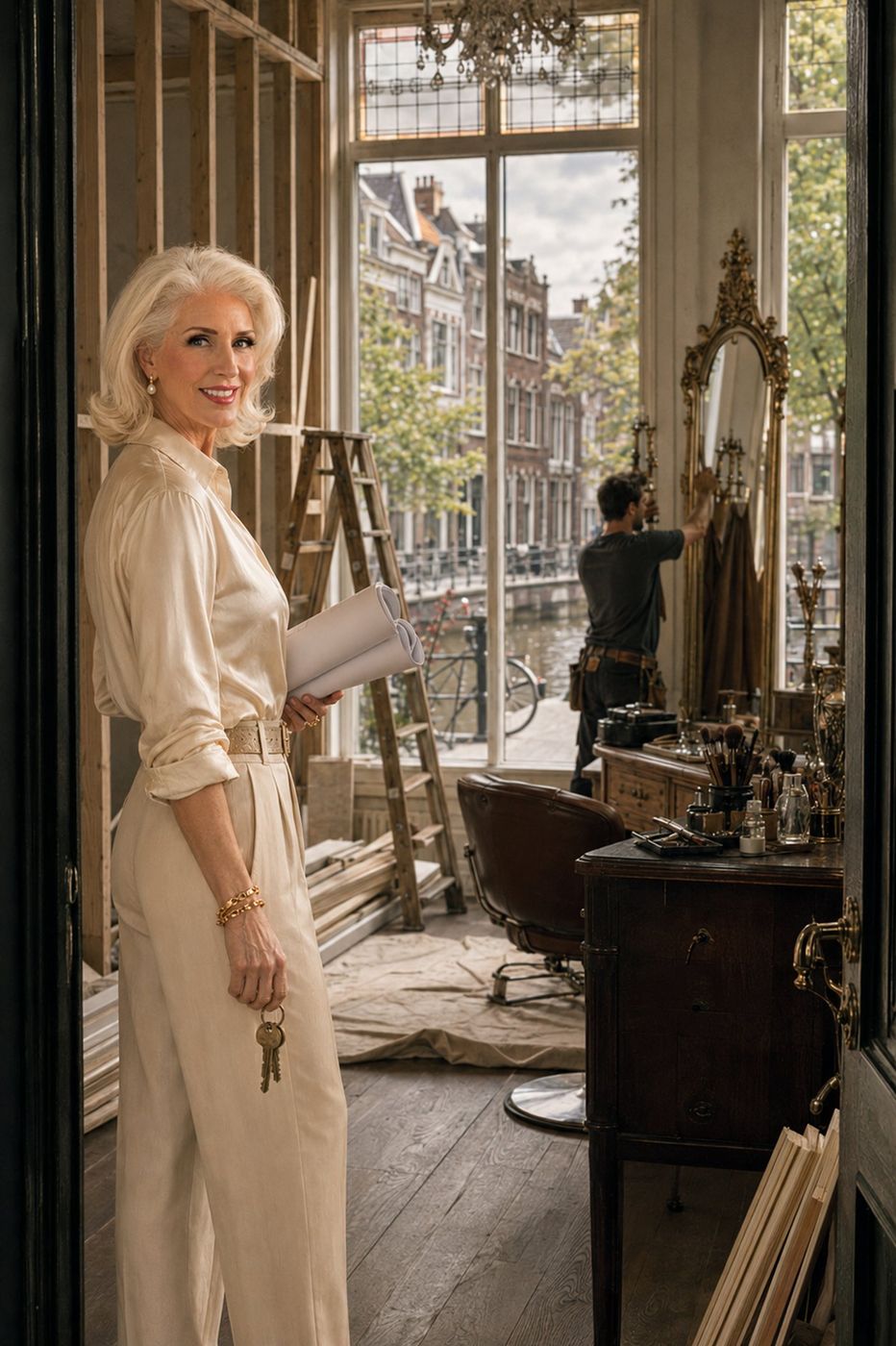
It was a wreck. Water stain down one wall, a floor that had to come up entirely, and a window at the front that ran nearly to the ceiling and looked straight out at the canal, which was the only reason I took it. I stood in the middle of that mess with my coat still on and I could see the whole finished room. I always can. It is the one thing I have never had to work at.
I put in four chairs, a wall of mirrors in old gilt frames I bought off a dealer in the Jordaan for almost nothing, and lamps instead of overheads, because nobody has ever looked at herself under an overhead light and felt better about her life.
We opened in October.
Here is what nobody tells you about the beauty business.
A woman sits down in your chair and she is looking at herself in a mirror for the next ninety minutes with a stranger standing behind her, touching her head. You cannot make eye contact for that long. It is too much. So you both talk to the reflection, and something about that, about the fact that neither of you is quite looking at the other one, turns the chair into a confessional.
They told me everything. They still do.

There was a woman named Marta who came in three days after her husband's funeral. She sat down and said, "Do whatever you want, I don't care," which in that chair is never true and always means something.
I did not do whatever I wanted. I washed her hair for a long time. I trimmed maybe a quarter inch, so little that it was frankly theft to charge her, and I put her hair up the way she had worn it in a photograph on her hall table that I had seen once when I dropped off product.
She looked at herself in that mirror and put both hands flat on the counter and cried for about four minutes while I stood behind her with my hands on her shoulders and said nothing at all.
Then she got up and paid and booked her next appointment.
People think this work is vanity. This work is not vanity. A woman who has stopped recognizing herself in a mirror is a woman who has begun to disappear, and sometimes the fastest road back into a life runs straight through the way you look in the glass. I have watched it a thousand times. It is not a substitute for the deeper work. It is very often the door to it.
I built and I built.
Cosmetology school more than once, honors both times, which I mention only because a woman who had been put in the slow class went and got honors twice. Salons in Europe and then salons in the States after we came back. Staff to train. Payroll. A medispa, later, with equipment leases that made my hands sweat.
The businesses worked. I need to say that plainly because of where this book is going. They were profitable and well run and people were glad to work for me.
What killed them, every single time, was not the market.
It was that when a marriage started to go, I would reach into the business for the wall that was holding it up. I would close a shop to nurse a husband. I would take my name off a door and go rent a chair in somebody else's place so I would have fewer responsibilities and more availability for a man. I would sell equipment to cover a household gap and tell myself it was temporary.
Every collapse in my professional life has a man's name on it, and not one of those men ever asked me to do it.
That is the part I had to sit with for thirty years before I could write it down. Nobody made me dismantle what I had built. I did it, in advance, unasked, as an offering. And then I was quietly furious that it had not been enough, and I could never say so, because what exactly was I going to accuse anybody of.
CHAPTER ELEVEN
What a Mother Chooses
The second divorce from the same man is the one where I made the worst decision of my life, and I made it in a lawyer's office in under four minutes.
He had the house. He had the income, the school district, the paid help, the whole assembled apparatus of a life. I had a job, a car, and a plan to go back to school.
The lawyer said, "And primary residence?"
And I heard myself say, "With their father."
I had rehearsed the reasoning for weeks. I knew what happened to divorced women in 1993 and I knew what happened to their children, and I was not going to move my daughter out of a house with a garden into an apartment over a laundromat so that I could feel like a good mother. I told myself I was choosing them over my own feelings. That is what I said, and there was truth in it.
There was also this, which took me twenty years to admit. I was terrified of failing at it. And a woman who visits on weekends cannot fail the way a woman who is there every night can fail.
We had joint custody. I saw them constantly. And it does not matter, because what a child registers is not the legal instrument. What a child registers is whose house the toothbrush lives in.
I went to Auburn and worked four jobs and lived, for one stretch, in a shack in a bad part of town with a hot plate and a chain on the door.
I loved it. That is the thing that surprises people.
English and math went the way they had always gone. But I was top of my class in art, and psychology took the roof off my head, because at thirty something years old somebody finally handed me the vocabulary for what I had been living inside since I was four. I read about attachment and I had to put the book down and go outside.
I was not there for a degree. I was there for ammunition. Graphic design so I could make my own materials, art because I had wanted it since the horses in the sand, psychology because I needed to know what was wrong with me.
And I got, at thirty, a shabby underfunded version of the young adulthood I never had. Friends. A retreat in the mountains where somebody played guitar badly. Staying up too late arguing about nothing.
Meanwhile, at their father's house, my daughter was drowning.
Clay had discovered around age nine that he could get his sister in trouble almost at will, and that his father would believe him, and children who discover that lever generally pull it. Shay was very much my daughter, which meant she defended herself, which meant she was difficult, which meant she was wrong before she opened her mouth.
I heard it in her voice on the phone for two years before I did anything.
Then I did the thing I actually am good at, which is that I went and got her. She moved in with me.
And within a year I married a man who became a problem for her too.
I am not going to give you a villain here. He was sick, genuinely and chronically sick, for most of the years we were together. He was frightened and he was in pain and pain makes people small. What he wanted was total availability, and he did not ask for it in a way anyone could have written down.
It went like this. I would mention a client. He would be quiet. Later there would be a comment about how tired he had been that afternoon and how long I had been gone. Never an accusation. Just weather.
So I closed the salon and went and rented a chair somewhere else. Fewer hours. More availability.
Then it was the horses. I had two by then, which was the one indulgence of my entire adult life, and boarding cost money and Saturday mornings.
"I just think," he said, "that if things are tight, that's an obvious place to look."
I sold them. I drove home from that barn and I did not cry until I was in the driveway.
Then it was Shay's school. He wanted her in the private one, the disciplined one, the one that would sort her out.
And I said yes to that too, because by then saying yes was simply what I did, and because a very tired part of me had begun to believe the story that my daughter needed sorting out.
It took about five months for me to understand what I had put her inside of.
It started with the visiting rules. Then the phone rules. Then a letter, in her handwriting, in language that was not hers.
That school was a cult. I am using the accurate word.
I called her father. My first ex-husband, the man from the bowling alley, the man I had spent eleven years failing to satisfy. I called him at nine at night and I said, "I need help and it has to be you."
And that man, who had made my life very small for over a decade, said, "When."
We got her out. The two of us, together, planned it like an operation and executed it and brought our daughter home, and I am not going to tell you the rest of it because it is hers.
I will tell you the one thing that belongs to me. Standing in a parking lot afterward with my hands still shaking, I looked at my ex-husband across the roof of a car and understood that we had just done the single best thing either of us ever did, and that we could only do it together, and that this did not redeem one hour of the eleven years.
People are not one thing. I have needed that sentence my whole life.
The marriage ended not long after.
I found out, months past the decree, that he had been involved with someone else for most of the last two years. The horses, the salon, the school. All of it during.
Here is what I did with that information, and it is the most important paragraph in this chapter.
For a long time I told the story as a theft. He took my horses, he took my business, he took my daughter's school years. And every word of that is accurate.
It is also not the useful truth.
The useful truth is that he never once took anything. He made a face. He went quiet. He mentioned that he had been tired. And I brought him my horses, my shop, my child's education, and set them down in front of him like offerings on a step, because somewhere in a field in 1970 a four year old worked out that if she made herself small enough and quiet enough and useful enough, the thing coming toward her might pass by.
He was not the danger. He was just the latest engine noise.
And I went still, the way I always had, and I called it love.
PART THREE
The Woman Who Performed and Disappeared
CHAPTER TWELVE
Scott
Scott made me laugh in the first ninety seconds, and I had been badly short of laughing.
He had the quality certain men have of arriving in a room that then rearranges itself slightly around him. Not loud. He never had to be loud. He would say something dry at exactly the right moment and the whole table would turn.
What undid me was that he was interested in what I did.
Not tolerant of it. Interested. He asked me about margins. He asked how I trained staff. Early on I was describing some problem with a build out and I looked up and he had gone and gotten a pen and was drawing the floor plan on the back of a receipt so he could follow it.
I was in my forties. I had been married twice to men who thought my work was a hobby I had instead of a personality. And here was a man turning a receipt over to draw my shop.
I would have followed him anywhere and I very nearly did.
The years with Scott are the years I became visible on purpose.
I was in my forties going into my fifties, which is the decade the world begins quietly asking a woman to lower her voice, dress sensibly, and stop drawing attention. I went the other way entirely.
I performed. I modeled again. I learned to dance.
I built characters the way other people build a wardrobe. A silver screen creature in white fur one weekend and something feathered and strange the next. Corsets, long gloves, headpieces I made myself at the kitchen table at one in the morning with wire and hot glue and a great deal of profanity. A cabaret woman in red. A white haired icon in black and gold.

People assumed it was escape. It was the opposite of escape.
As a child, being looked at was dangerous. Attention was the motorcycles. Attention was a photographer saying the light is better in the back. I had spent forty years managing how much of me was visible at any given moment, and doing it out of fear.
On a stage, I chose. I chose the entrance, the fabric, the exact half second when the thing turned. For the first time in my life being seen was something I was doing rather than something being done to me.
And then there was the dancing, which was different again, and deeper.
I had not been inside my own body in years. I had run it, fed it, dressed it, criticized it, used it to hold other people up. I had not lived in it. And then I was barefoot on cold sand with red silk going out behind me in the wind and eight pounds of fabric in each hand, and there was no thinking involved at all, and I came off that beach shaking and laughing and more awake than I had been in a decade.

For the first time in longer than I could calculate, I was not managing my survival.
I was just alive, on a Tuesday, for no reason.
CHAPTER THIRTEEN
Staying
I found out the way people always find out, which is that I already knew and had been declining to know it for about seven months.
The knowing lived in small places. A phone turned face down on a counter. A Saturday that got vague. The particular over-explanation of a man accounting for four hours nobody had asked him about.
I want to be honest about what I did with all that evidence, because this is the chapter where I stop being able to blame anybody but myself.
I built him an alibi. In my own head. Every single time.
He is under pressure. This is what that looks like. I am being suspicious because of what happened before, and it is not fair to make him pay for two other men.
Do you see the machinery? Twice I looked directly at the thing and then chose, deliberately, to be a woman who had not seen it. Because the alternative was a conversation, and the conversation had one possible ending, and I was fifty two years old and I did not want to start over.
That is the truth of why women stay, or it was the truth of why I did. Not weakness. Arithmetic. I had run the numbers on being alone again and they came out worse.
When it finally came apart, it came apart in an ordinary kitchen on an ordinary evening, and what I remember most clearly is how calm I was.
I did not shout. I have never once in my life shouted at the moment it would have been useful.
I said, "How long."
And he told me, and it was longer than I had allowed myself to suspect, and I stood there with one hand on the counter and did the thing I have done since I was four years old, which is to go completely still and wait for it to finish coming at me.
Then I said, "Okay."
He said, "Misty, say something."
"I said okay."
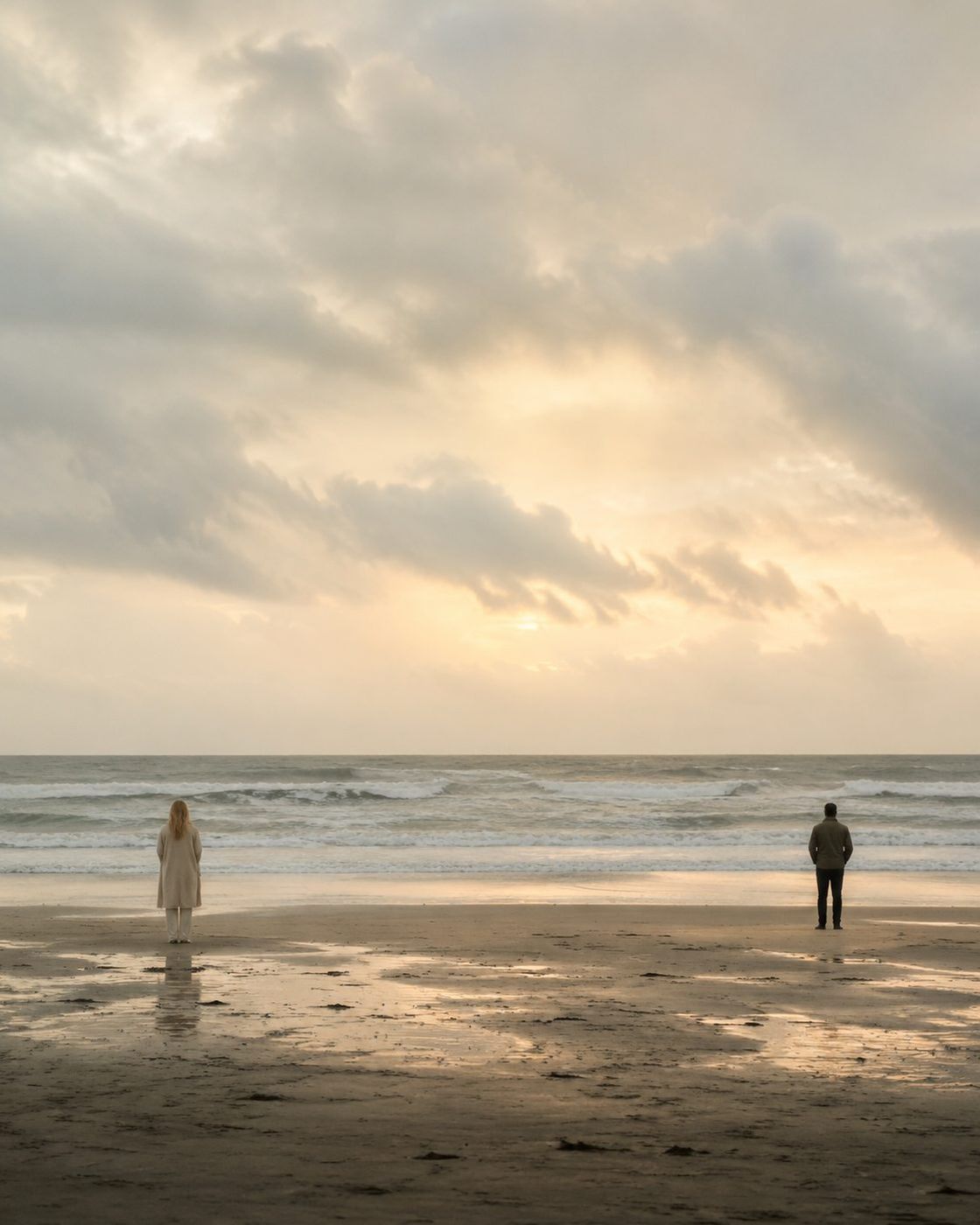
Here is the part of this story that people find difficult.
Scott and I are friends. Not politely. Actually.
It took a couple of years and a great deal of distance, and then one day he called about something practical and we talked for an hour, and now he is one of maybe four people who would know something was wrong from the first sentence I said on a phone.
Of all the men in this book, he is the one I loved most. Some part of me will not entirely give that up and I have stopped fighting with it.
What I have finally understood is that a relationship can fail completely in the shape it was meant to take and still leave something real behind, and that being able to hold both of those things is not weakness or self deception. It is just accuracy.
But sitting alone in that house after he moved out, I was not able to be philosophical.
I was fifty two. I had built businesses on two continents. I had put three marriages in the ground. And I was standing in a kitchen at midnight in a robe, eating standing up out of a pan, and I could not answer a very simple question.
Who am I when there is nobody in the house to be excellent for.
I had no answer. And the not knowing was so loud that I went looking for something, anything, that would make me feel like a person taking action.
I found it about eight months later, on the internet, at two in the morning.
CHAPTER FOURTEEN
The Body Keeps Asking
By then I was two hundred and twenty five pounds and I had stopped being able to find myself in a photograph.
The weight had come on over four years the way it comes on, which is invisibly and then all at once. Grief eats. Stress eats. A woman alone in a house at midnight eats standing up out of a pan.
And I want to be precise about the feeling, because it was not vanity and it was not really about the number.
It was that I had spent my entire life being able to change things. Rooms. Businesses. Other women's faces in a mirror. The one thing I could not change was the thing I was carrying around all day, and every mirror in my house had turned into a report card on my own competence.
So when I found the clinic, what I actually felt was not hope.
It was relief at finally having something to do.

My daughter called me from California when I told her.
"Who's going with you?"
"It's four days, Shay. It's outpatient practically."
"Mom. Who is going with you."
"Nobody's going with me. It's fine. I've done harder things by myself."
And there it is. Right there, in one sentence, is the whole book. I've done harder things by myself. Said with pride. Said as a qualification.
She said, "That's not the flex you think it is."
My daughter was thirty and she had my number completely and I hung up on her, gently, the way you can hang up on somebody without them being able to say afterward that you hung up on them.
People pushed back. I need that on the record because it matters for what comes after. Two friends and a surgeon in Atlanta all told me some version of don't.
I heard them. And underneath them I heard something louder, which was a voice saying do something, now, whatever it costs.
Thirty years earlier, in a drive-through with a paper cup in my hand, a voice had said put your seat belt on and I obeyed it without argument and it saved my daughter's life.
This voice was not that voice. This one sounded almost the same and it wanted the opposite. It was not protection. It was panic wearing protection's coat, and the only instruction panic ever gives is anywhere but here.
I could not tell them apart. That is the whole tragedy of it. I had proof that my instincts were worth obeying, and I used that proof to justify obeying the one instinct that was going to nearly kill me.
I flew from Atlanta to Mexico by myself on a Tuesday.
Nobody in the next seat. Nobody at the gate. A driver with a laminated sign, a clean facility, a surgeon who was perfectly pleasant. And a clipboard of consent forms in a language I do not read, which I signed on a plastic chair, alone, because there was nobody with me to say wait, what does this paragraph say.
I woke up in recovery in a room with three other women, all of whom had somebody sitting beside them.
I flew home four days later and took a taxi from the airport.
It did not go wrong all at once. That is not how a real disaster works.
It went wrong the way water gets into a house.
First I could not keep anything down, which they said was normal. Then the fevers, which they said would pass. Then a night in an emergency room in Georgia with a doctor holding my scan up and saying, "Who did this?" in a voice I did not like at all.
Then two years.
Two years of hospitals as a recurring feature of a life. Admitted, treated, released, home for eleven days, back again. The same tubes. The same monitors. The same careful voice explaining a thing to me at four in the afternoon in a way that was designed to keep me calm.
I went from two hundred and twenty five pounds to a hundred and fifteen.
Here is what nobody understands unless they have lived it. That number had been the entire object. That number was what I flew to Mexico for.
And I got to it, and got past it, and every pound after was not achievement but subtraction. I would stand on a scale and watch it go down and feel afraid. That is a strange sentence to write. I had spent forty years wanting a smaller number and when it finally came it arrived as a symptom.
I nearly died more than once in those two years. I am not saying that for effect. I am saying it because the rest of this makes no sense without it.
And the hardest part of those two years was not the illness.
People are wonderful at a crisis with edges. A car accident, a diagnosis with a treatment plan and a date. They will bring food and drive you places and sit in a waiting room for six hours.
A long illness asks a different thing. It interrupts too many times. It repeats past the point where checking in still feels urgent. And it frightens people, because it does not resolve, and there is nothing to do, and standing next to something you cannot fix is unbearable for a certain kind of person.
They start to step back. Not cruelly. They just get busy.
And I made it easy for them, because I was still that woman, and every time somebody asked how I was doing I said fine.
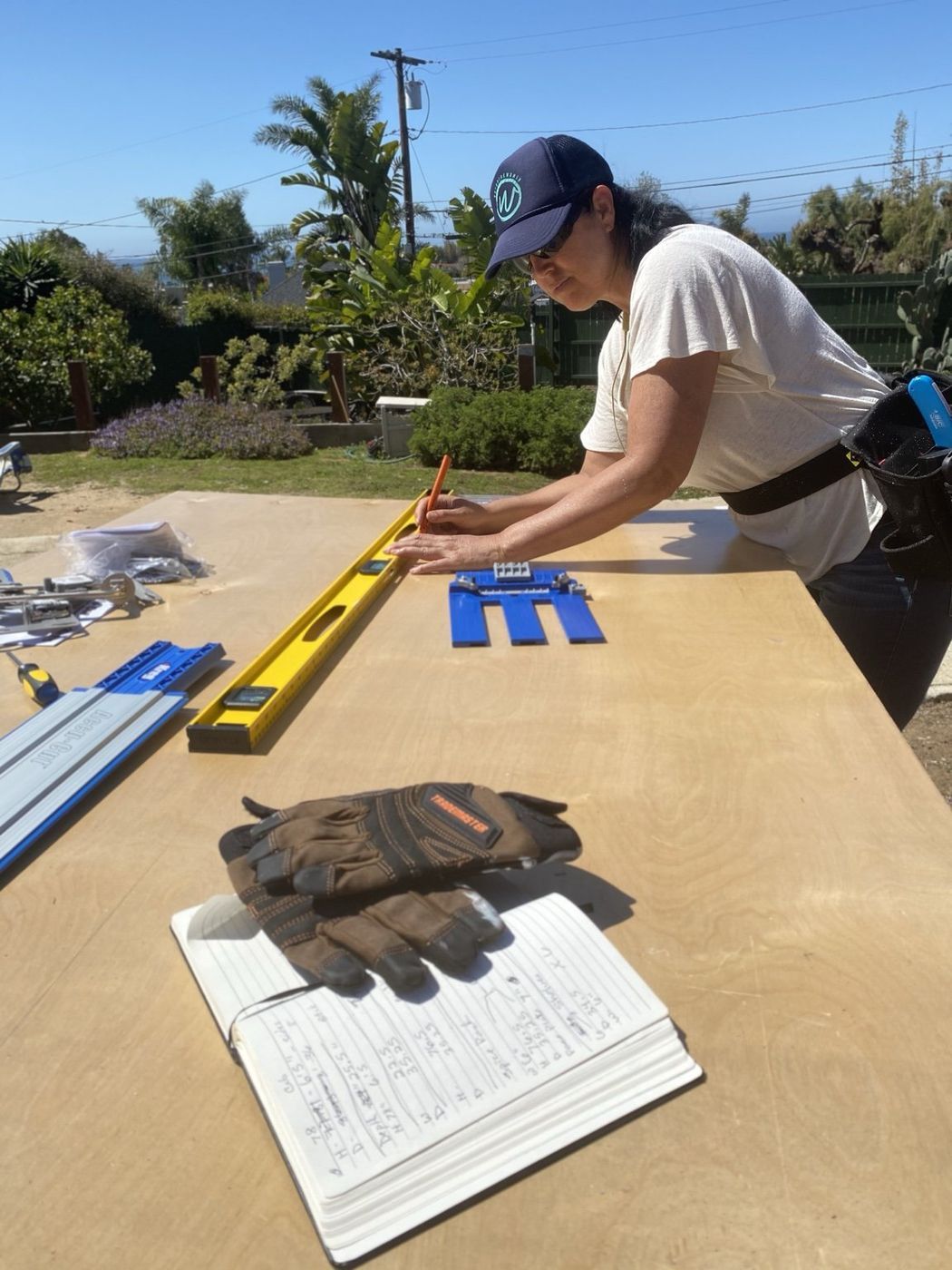
I kept working in the gaps. I stood over a sheet of plywood in a driveway between hospital stays with a level and a pencil, measuring a line, because some part of me needed evidence that I could still make something exist.
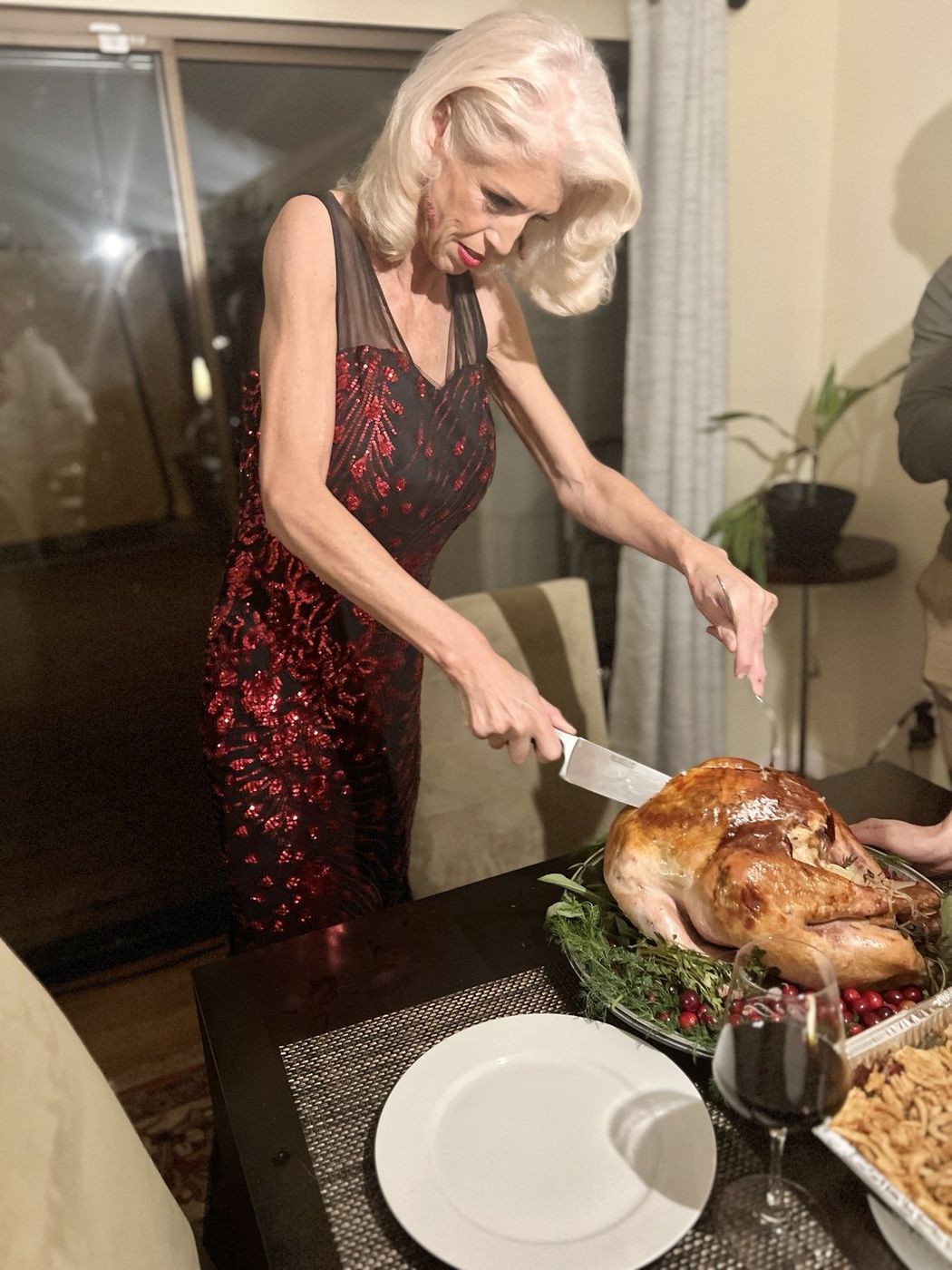
I cooked meals I could not eat and made them beautiful. There is a photograph of me carving a turkey in a sequined dress with my hair done, and I am smiling in it, and I weighed a hundred and twenty pounds and had a drain in my side under the fabric.
And a month before the surgery that would finally repair the damage, I stood on a beach in white lace with the wind coming off the water and let a photographer take pictures of me.

Those photographs are beautiful and they are the most dishonest images I own.
Anybody looking at them sees a slim, elegant, composed woman and concludes she is well and that something has gone right for her. They cannot see the two years behind the frame. They cannot see the surgery eleven days ahead of it.
I am not telling you this to argue anybody out of surgery. I am not qualified and it is not my business.
I am telling you because I know exactly how it feels to be so tired of a body that you will hand it to a stranger in another country to be fixed, and because by the time they wheeled me in for the last operation I had stopped caring about thin altogether.
I was only trying to stay alive.
PART FOUR
The Woman Who Came Back
CHAPTER FIFTEEN
The Beeping Room Revisited
We are back in the room where this began, and now you know how I got here.
The final surgery was not a revision. It was a rebuild. They opened me from the sternum down, took out what the first operation had done, repaired what could be repaired, reconstructed the rest, and closed me with a line of staples that ran the length of my torso.
I was in that hospital for three weeks.
Three weeks is long enough for the extraordinary to become the furniture. By day four the IV pole has a personality. By day nine the gown is simply what you wear. Time stops being morning and afternoon and becomes the schedule instead. Vitals. Rounds. The walk to the end of the corridor and back, which on Tuesday is eleven doors and on Thursday is fourteen, and you are absurdly proud of the three doors.
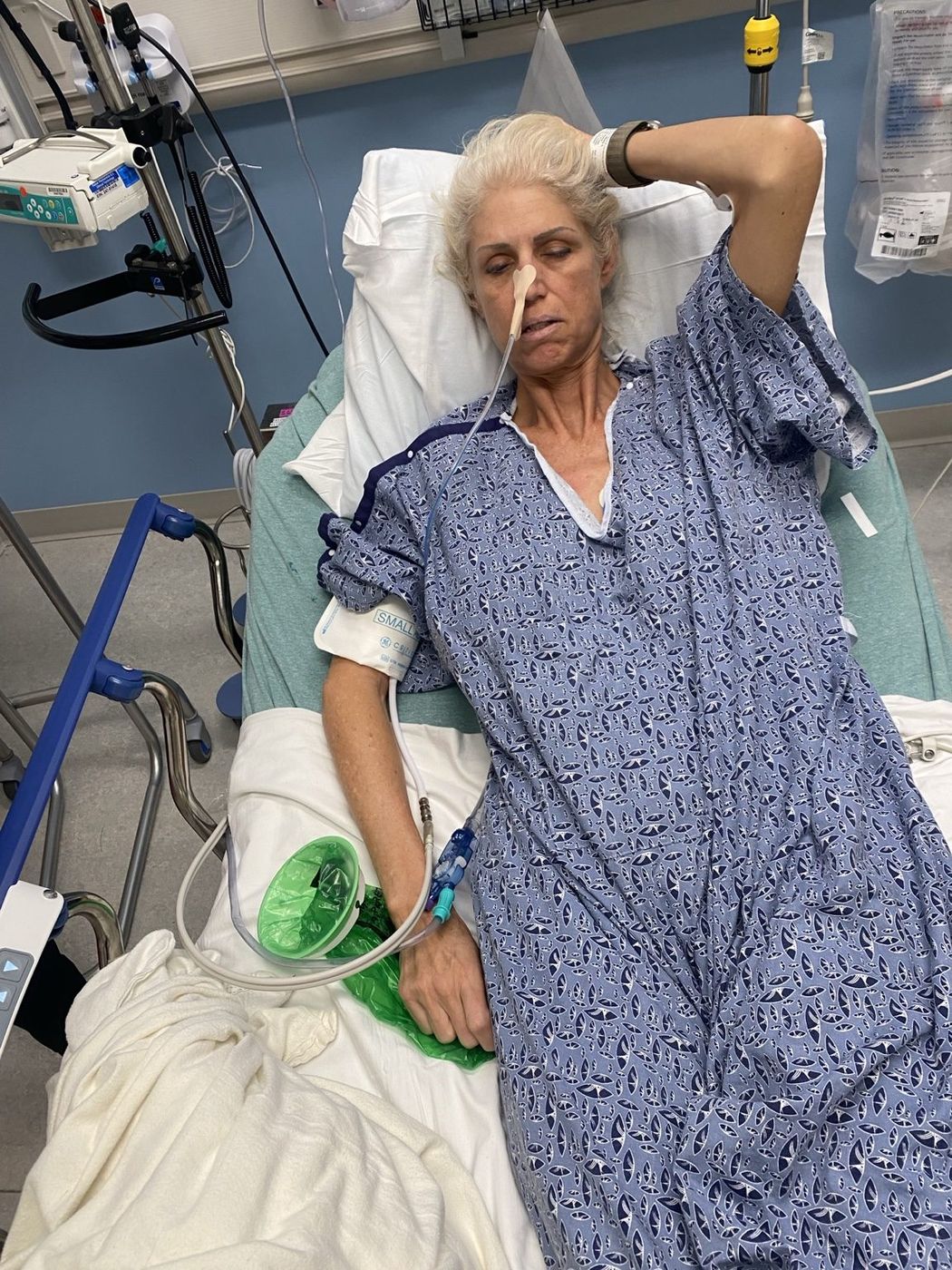
On the fifth or sixth day I asked a nurse to help me get to the bathroom, and I stood in front of the mirror in there and pulled the gown open and looked at it for the first time.
I had been avoiding it for days by simply not turning my head in the shower.
It went from just under my breastbone down past my navel. Puckered, angry, held together with metal. The skin around it was yellow going into green where the bruising had started to turn.
I stood there holding the sink and I waited to feel grief about it, because that is what I had been braced for.
What came instead surprised me so much that I said it out loud in an empty bathroom.
"Well," I said. "You held."
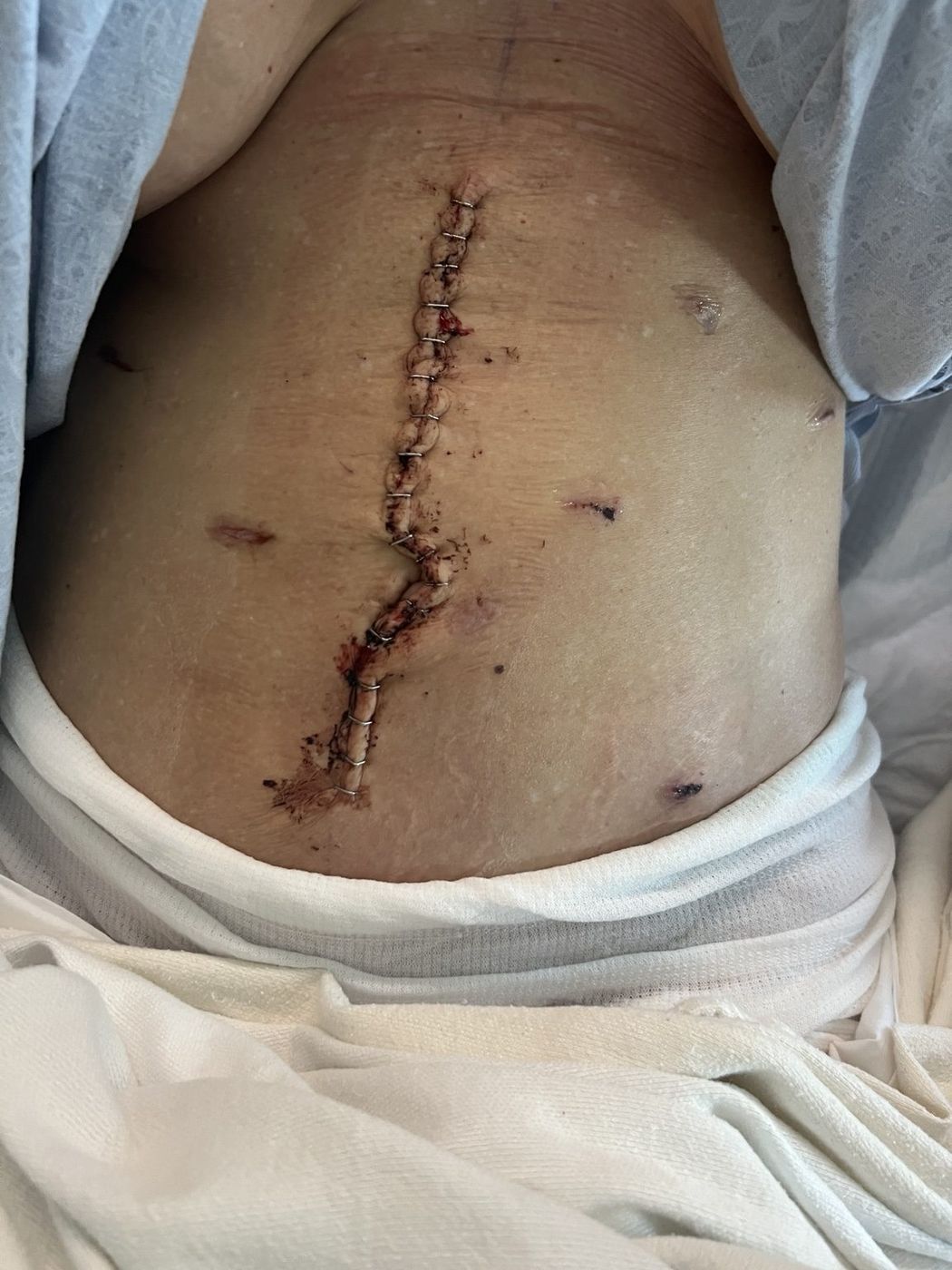
I did my hair in that hospital. Every day I was able to lift my arms.
I put makeup on. I asked a nurse to bring my bag up from the closet on the second morning and she raised an eyebrow at me and got it.
People assume that was denial. It was the exact opposite of denial. Illness had already taken my work, my weight, my calendar, my privacy, and my ability to walk fourteen doors without counting. Lipstick was the last thing in that building that was mine to decide, and I decided it every single morning, and I would do it again.
He came on the Thursday.
I had been seeing him for about eight months before all this started. A kind man, genuinely kind, funny, thoughtful about small things. He came in with a bear.
A big soft brown teddy bear, the sort of thing you buy in the gift shop downstairs because you have to walk in holding something.
He sat in the chair for a while and talked about a road closure and his sister's dog and how the parking here was impossible, and I lay there and watched him not look at the IV pole, and I understood what the bear was before he did.
Eventually he ran out of parking.
"Misty," he said. "I have to be honest with you."
"You don't, actually," I said. "But go ahead."
He said he was not built for this. He said it decently. He said he had thought he could do it and he had watched himself for two months not be able to do it, and that I deserved somebody who could.
And I lay in that bed with staples down the middle of me and did the thing I have done my entire life.
I made it easy for him.
I told him it was all right. I told him I understood, and I did understand. I asked about his sister's dog again. I let him off so gently that he was able to walk out of that room without ever having had to sit in what he had just done.
Then the door shut, and it was me and the bear and the counting.
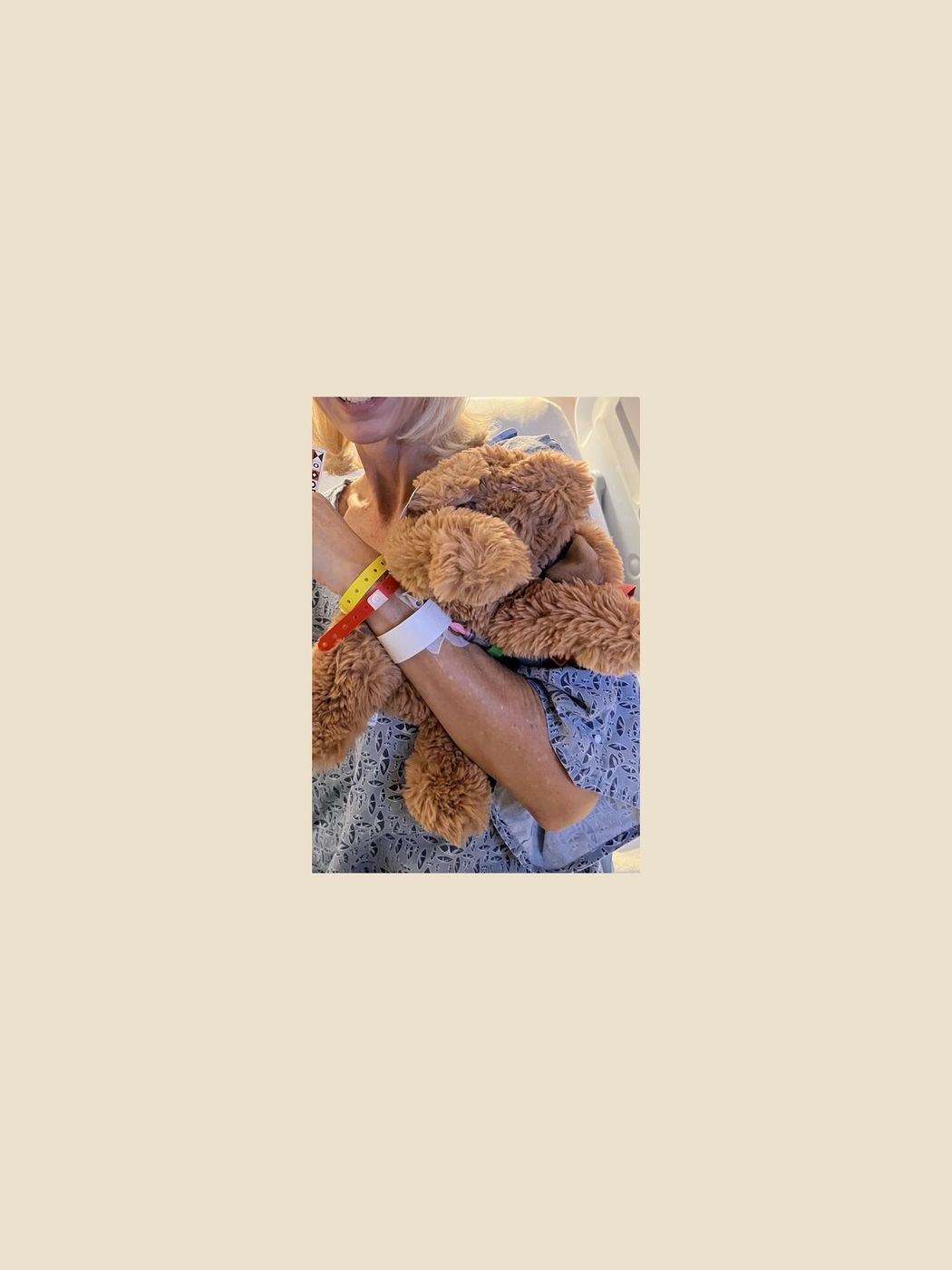
Somebody took a photograph of me a little while after that, holding it, and I am smiling.
I look at that picture now and I do not see a brave woman.
I see a woman doing the only trick she has ever known, one more time, in the worst possible circumstance. Go still. Wait it out. Tell them it was fine.
That is the moment. Not the surgery. Not the scar. That afternoon, with a stuffed animal I did not want, comforting a man who was leaving me because I was too much trouble to be sick around.
Something in me finally ran out.
CHAPTER SIXTEEN
The Scar
The next morning I asked for paper.
The aide who came in to do my water thought I meant something to sign.
"No," I said. "Drawing paper. And pencils. Colored ones if anybody's got them."
She looked at me the way people look at you in there when you ask for something that is not on the list. Then she said she would see, and about four hours later she came back with a pad and a plastic box of colored pencils that had somebody's child's name in marker on the lid.
I have wondered about that kid ever since. I started drawing faces, because faces were what came.
Women, mostly. Enormous eyes looking straight out of the paper at whoever was going to look back. Hair that turned into ribbons and then into water and then into weather. I did not plan any of it. My hand simply went.
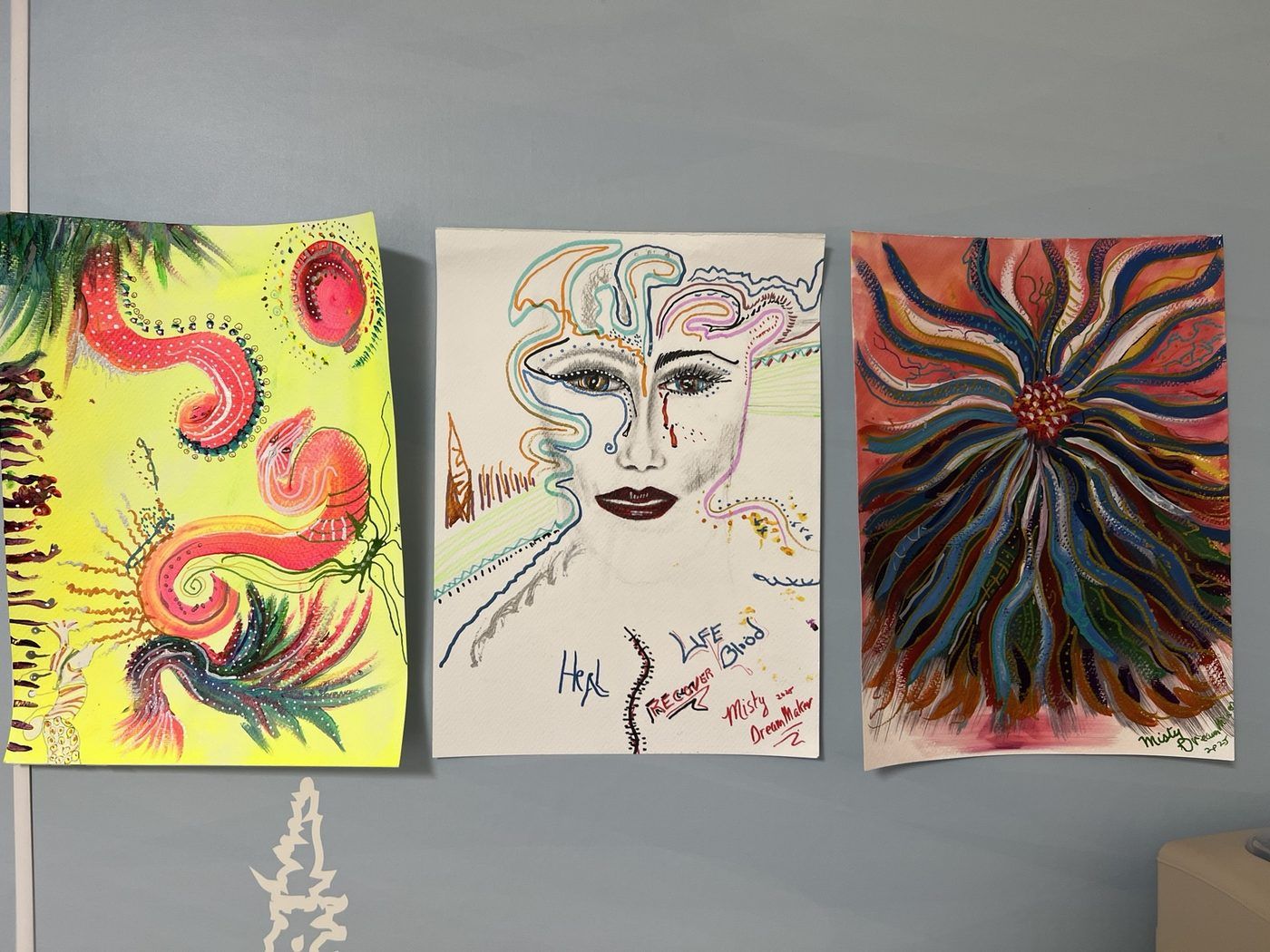
Then one afternoon I drew a body, and the body had a line down the middle of it.
I did not decide to do that. I got to the abdomen and my hand put in a seam, stitched, closed, exactly where mine was under the blanket, and I sat back against the pillows and looked at what I had just done and my ears went hot.
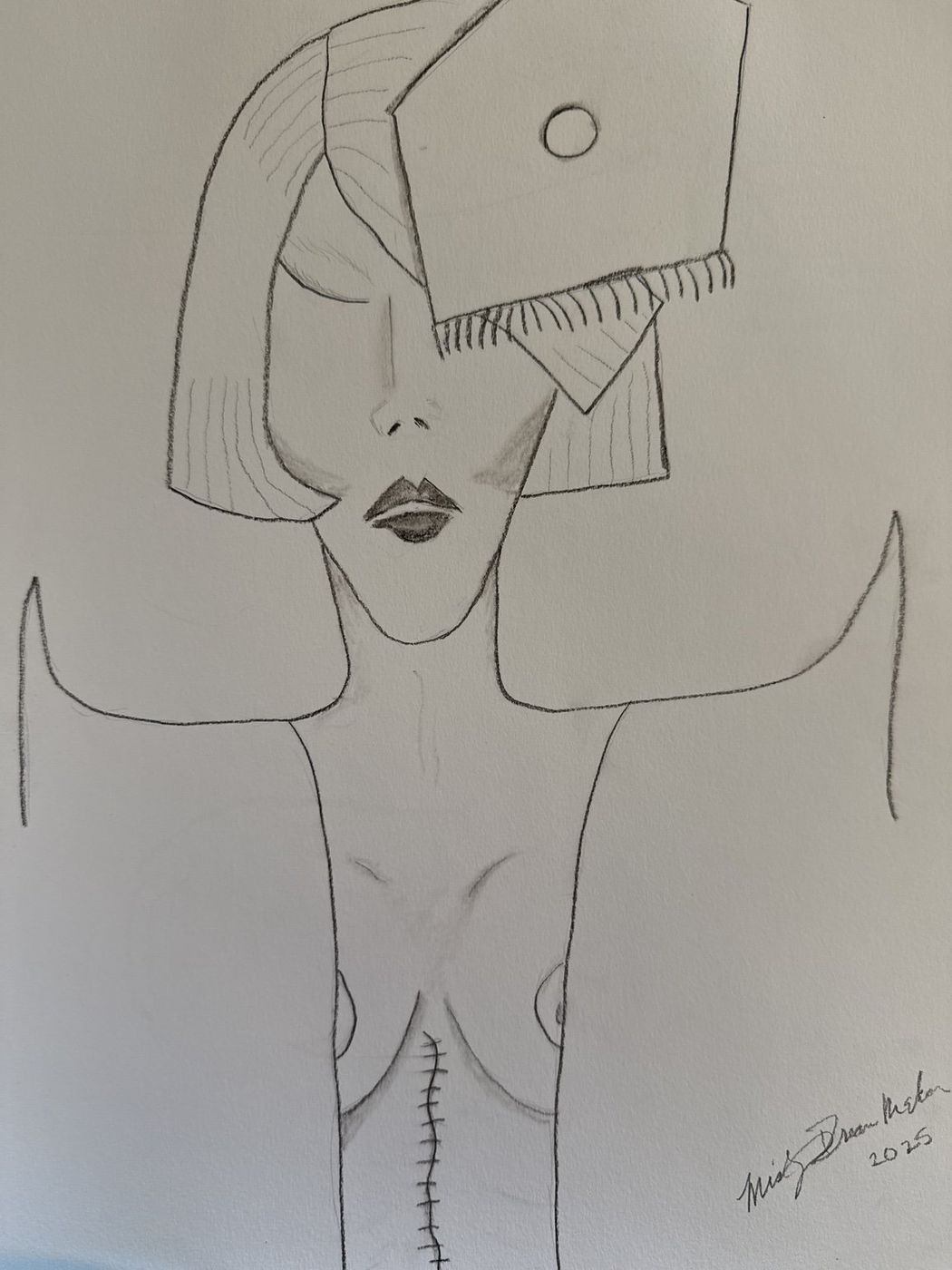
On another page I wrote words around a face. HEAL. RECOVER. LIFE. BLOOD. Not a plan and not an affirmation. Four words that were simply the loudest ones in the room that day.
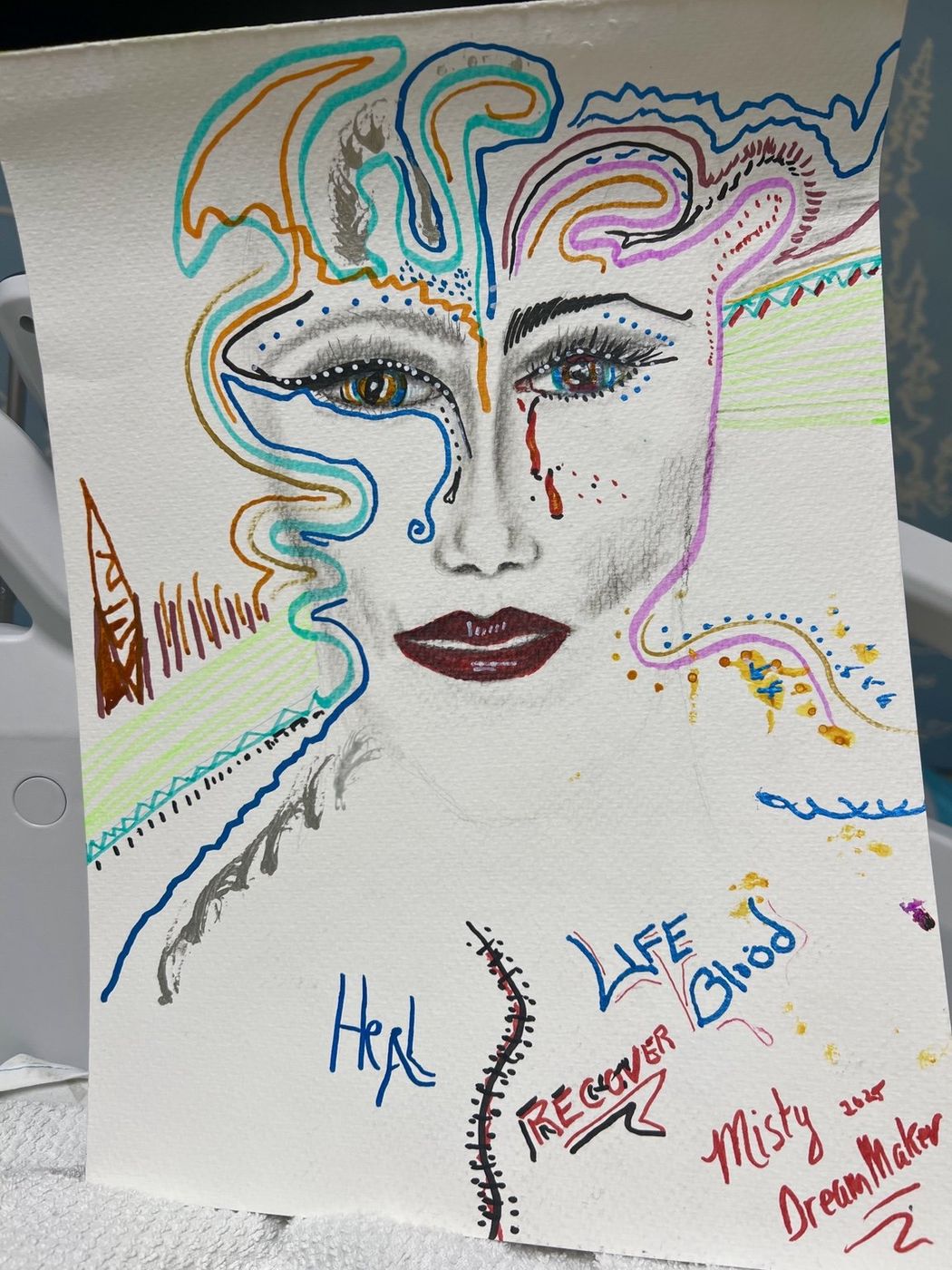
None of it is skilled work. I was on medication and I could not sit fully upright. It is not the art of a woman looking back on a hard time from a safe distance.
It came out of the middle of the thing, which is why it is the only honest record I have of it.
I taped four pieces up on the wall opposite the bed with surgical tape.
The room changed. All the equipment was still in it. But now there was also somebody in there who made things.
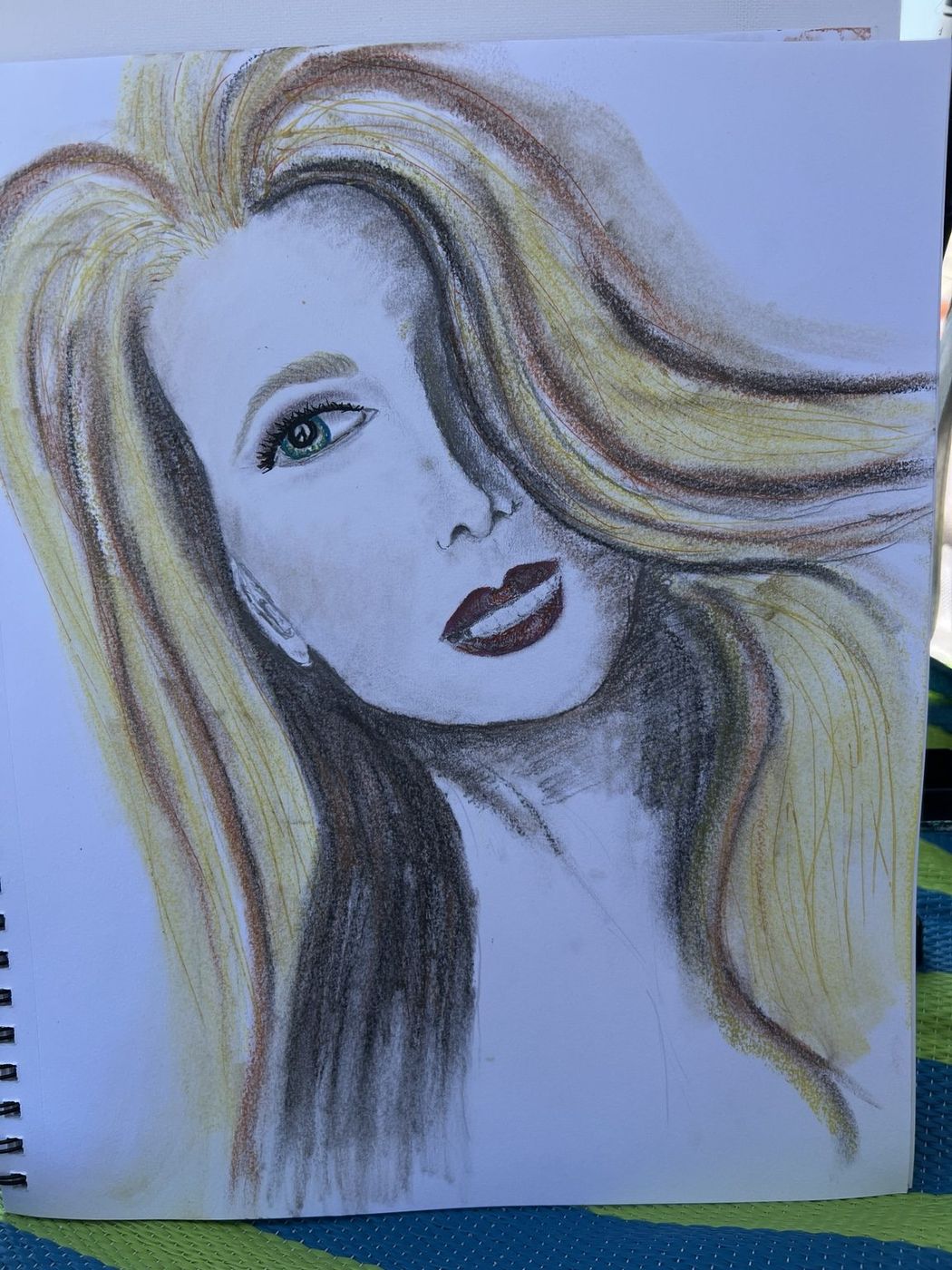
A doctor came in on my last week, a woman I had not met before, covering rounds. She looked at the wall for a moment longer than a busy person looks at anything.
"Did you do these?"
"Yes."
"In here?"
"There isn't anywhere else."
She looked at the one with the seam in it. Then she looked at me, and she said, "How are you doing? Actually."
And I opened my mouth to say fine.
I want you to know that the word was formed. It was in my mouth. Fifty six years of muscle memory had already loaded it.
And I heard myself say, "Badly. I'm doing badly. Somebody I was seeing came in on Thursday and left me here, and I made it comfortable for him while he did it, and I have been doing that my entire life and I do not know how to stop."
She did not flinch. She pulled the chair over and sat down in it, which no doctor in two years had done, and she stayed about ten minutes.
I do not remember one word she said.
I remember that I told the truth to a stranger and the room did not collapse and she did not leave and nothing bad happened at all.
That is the first brick. That is where it actually starts. Not with the surgery, which was only survival, and I had always been able to do survival.
It starts with a woman in a hospital gown answering a simple question honestly for the first time in her adult life.
CHAPTER SEVENTEEN
Coming Back for Her
I went home in March with a folder of discharge instructions and a wall of drawings rolled up under my arm.
Recovery is boring and nobody writes about it, so I will be quick. It was months. I got stronger in a slow uneven way that made me furious. I learned to eat again in small strange increments.
And I did a thing I had never done in sixty years, which was to sit still with nothing to fix.
That is where the hypnotherapy came from, if you want the practical version. I went looking for a way to understand what had happened in that room, and I ended up certified in it, which surprised nobody who knows me. I do not know how to study something without ending up licensed in it.
What it gave me was not a technique. It was a diagram of a mechanism I had been operating blind for half a century.
A four year old crosses a field. The field is genuinely dangerous. She invents a procedure, and the procedure works, and because it works it is never revisited. It simply gets carried forward and applied to a fourth grade bedroom and a bowling alley and a marriage and a business and a hospital room, and every time it works well enough to get her through the afternoon, which is the trap. It never fails badly enough to be examined.
Go still. Wait it out. Tell them it was fine.
That is not a character flaw. That is a four year old's excellent solution to a real problem, still running fifty six years after the problem was over.

The test came about fourteen months after I came home, and it did not look like a test at all.
A man I had known for years called with a proposition. He was starting something and he wanted me to build it. Systems, staff, the client experience, all of it. My exact skill set. Real money eventually, though not at first, and there is always a not at first.
We had lunch. And forty minutes in he said the sentence.
"Obviously in the beginning I'd need you all in. Nights, weekends, whatever it takes. Your own stuff would have to go on hold for a while."
Your own stuff.
My own stuff was a business I had been rebuilding for a year with the strength I had left.
And I want to tell you exactly what happened in my body, because this is the whole book. My mouth started to say yes. It did. Sixty years of machinery came up the track right on schedule, and it had reasons ready, good ones, generous ones. He needs me. It's temporary. I can pick mine back up after.
And underneath that I felt something else entirely, which was a cold flat quiet in my chest that I recognized.
It was the same signal from the drive-through. Not louder. Just clear.
I put my fork down and I said, "No."
He laughed, because I had never said that to anybody.
"No to which part?"
"To all of it," I said. "I'm not putting mine down again."
And then, because the machinery was still running and wanted very badly to repair the moment, I felt the apology coming up. The softener. The but let me think about it, the maybe I could do two days, the little bridge I have built for every uncomfortable man in my entire life so that he would not have to stand in the discomfort by himself.
I did not build it.
I sat there and let the silence be his to hold.
It lasted maybe four seconds and it was the hardest four seconds of my adult life. He was annoyed. He got over it. We are fine.
That lunch is worth more to me than the surgery. Surviving was never the achievement. I have always been able to survive.
Saying no to a person I liked, and then not fixing his feelings about it, is a thing the woman in the bowling alley could not have done, and the woman in Amsterdam could not have done, and the woman holding the teddy bear could not have done.
That is what change actually looks like. It is not a moment of light. It is a fork going down on a table.
EPILOGUE
Across the Field
I went back to Huntington Beach.
Not for anything. I was driving down from Los Angeles with an afternoon to spend and I took the exit without deciding to.
The field is not there. Of course it is not there. There is a shopping center and a road that did not exist and a self storage place, and I sat in a rental car in that parking lot for about twenty minutes feeling foolish.
Then I got out and walked to roughly where I thought the middle of it had been, which is now somewhere between a tire shop and a fence.
And I stood there in the ordinary California afternoon and I could hear them.
Not really. I want to be accurate. But that sound is in me the way a first language is in you, and standing on that asphalt I could hear the whole field going, that iron creak and sigh coming out of sync from every direction, and I could feel a lunch bag held against my chest with both arms.

For most of my life I told that story as a triumph.
Look what she did. Four years old and she crossed it alone, and she crossed it again the next day, and she never once complained.
I have retired that version.
Here is what I see now when I look at her. I see a four year old who should not have been in that field by herself. Not because she could not do it. She could do it, obviously, she did it for two years. But her being able to do it was never the same thing as her needing to.
Her surviving it was remarkable.
Her being alone in it was not a virtue, and I spent fifty six years quietly treating it as one, and built an entire personality on top of that mistake.
So I have started doing something in my head, and I am going to tell you about it even though it sounds strange.
I put the field back. All of it, the pumps and the grass and the light going yellow at the far end. And I put her in it, in the dress with the collar my mother straightened, holding the bag.
And then I put a woman at the other end.
She has white hair. She has crossed oceans and opened shops and closed them. She has been a bride at seventeen and a patient at sixty. She has been left, and she has left, and she has stood in a kitchen and made it easy for a man to walk out of it.
She does not tell the girl it is going to be fine, because that is the lie the girl is already learning to tell, and she is finished lying to this particular child.
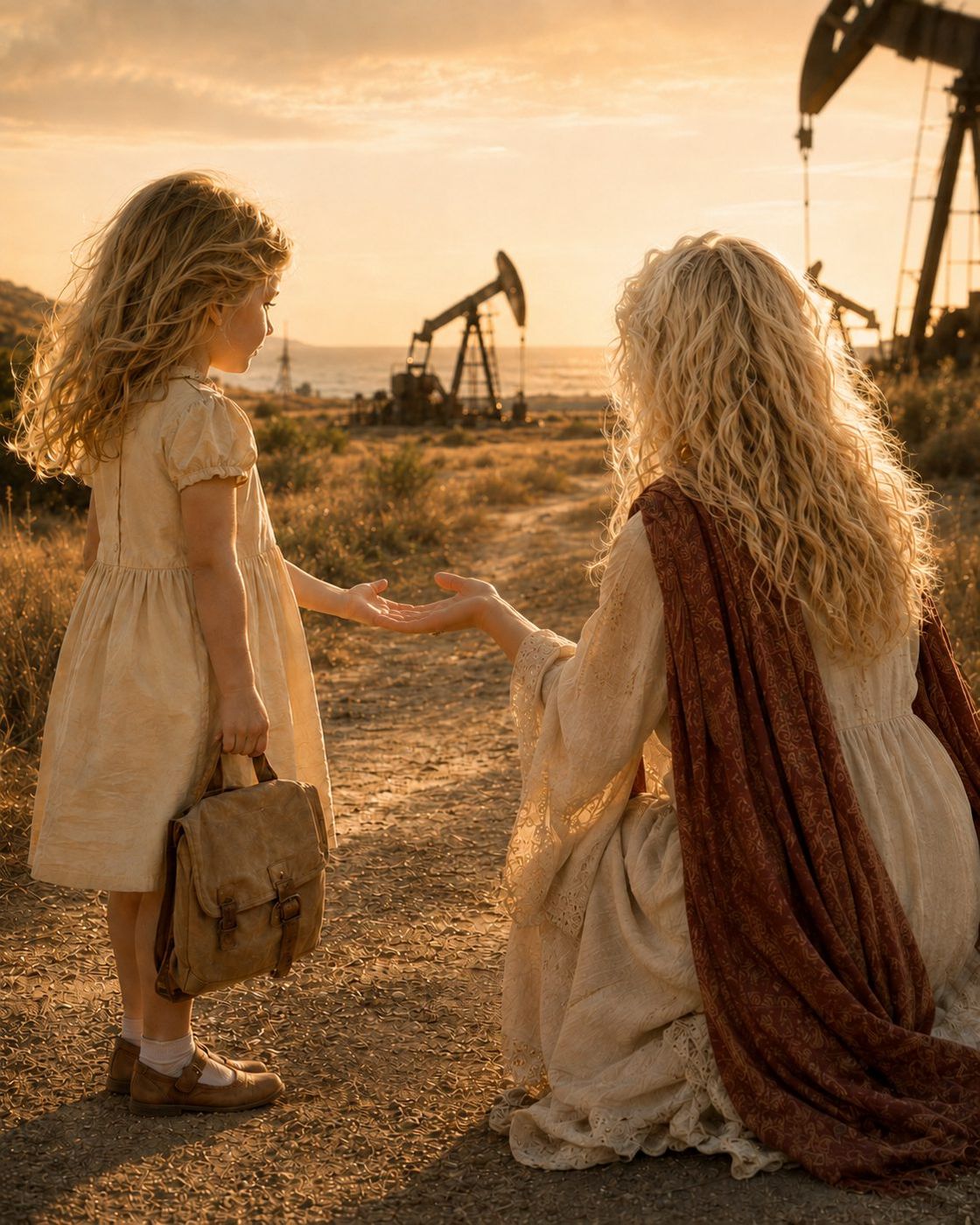
She kneels down in the dirt so their eyes are level, and she says the four things nobody said.
You were never slow.
You were never too much.
You were never impossible to love.
None of it was ever the measure of what you were worth.
Then she holds out her hand, and she does not explain, and she does not hurry her.
And the girl takes it.

They walk it together, all the way across, until the iron sound falls off behind them and there is water instead. I am not at the end of anything. I want to be careful about that, because I have read too many books that finish with a woman arriving somewhere final and serene, and I do not believe them.
I am sixty one. I am building again. It is going slowly and some months are frightening.
What is different is small and it is everything.
When somebody asks me how I am, there is now a half second where I choose the answer instead of producing it. I do not always choose the true one. But there is a gap there that was not there before, and everything I have now lives inside that gap.
My great grandmother told me the whole thing in a shed with a dirt floor when I was five years old and I did not understand a word of it for fifty five years.
It is not that some jars are special and the rest are ordinary.
It is what you hold them up to.

About the Author

Misty Klein is a certified hypnotherapist, master cosmetologist, medical aesthetician, artist, and the founder of DreamCasters Compass. She has built and run businesses on two continents, taught, performed, and spent four decades helping people see themselves clearly enough to change something. She lives in Georgia.
Held to the Light is her first book.